Showing posts with label creation. Show all posts

Tuesday, September 15, 2009

On God's Creation And God's Election

Anyone that reads Reformed theology will soon come to know that God's elective acts are firmly rooted in God's creative acts. Whereas all Reformed theology gets it right to tie the act of God's creating to God's electing---I must part ways with the Calvinist stripe of Reformed theology on several points of Tulip theology. First of all, Tulip theology is mainly associated with predestination though predestination has nothing to do with Tulip theology. Here are all the points of Tulip: Total Hereditary Depravity, Unconditional Election, Limited Atonement, Irresistible Grace and Perseverance of the Saints. I agree with most all of these points except for the way that Calvinists define them.

On Total Depravity---whereas depravity of humanity is true, no state of depravity is total or else experience of God's salvific power would be impossible even if by the sole act of God. Rather humanity is in a state of spiritual blindness until the Holy Spirit prompts individuals to respond to God's effectual call. Arminian Today: Article 3: An Arminian Commentary on the Five Articles of the Remonstrance, Classical Arminianism: WHAT IS CLASSICAL ARMINIANISM? PART THREE: TOTAL DEPRAVITY, John Fletcher on Being “Dead in Sin” Once then when an individual responds to God's effectual call via the Holy Spirit's prompting then the individual's will is totally freed from the bondage of sin.

Election is both conditional and unconditional depending on the ontological and empirical object and subject of election. Unconditional election then is only true of Christ, for Christ is both elected and reprobated for us in the event of the Incarnation and the Crucifixion and in the harrowing of hell. Jesus as elected one pertains to Jesus being elected as both God and man for us from the foundation of the world. Jesus was reprobated for us in the moment during His Incarnation that He became sin for us at the advent of the Cross. http://theevangelicalcalvinist.blogspot.com/2009/08/karl-barths-election-alternative-to.html, ::: How Barth’s Doctrine of Election Informs His Doctrine of Justification ::: The election of individual believers then is conditional upon Christ then as all who are in Christ are elected in Christ and must continue in faith and belief in Christ in order to be saved. Classical Arminianism: EN CHRISTO Election then is a matter of Christological truth rather than a random and arbitrary act of determinism.

The Atonement is both limited and unlimited depending on the effects of the Atonement one is talking about. The full effects of the Atonement are limited in scope but not in number. The scope by which the Atonement's full effects are limited is that only those who have true faith and belief in Christ shall be saved---which is the full effect of the Atonement---salvation. Arminian Today: The Extent of the Atonement, Classical Arminianism: LIMITED ATONEMENT: BIBLICAL MANDATE OR SYSTEMATIC PRESUMPTION? (PART ONE), Classical Arminianism: LIMITED ATONEMENT: BIBLICAL MANDATE OR SYSTEMATIC PRESUMPTION? (PART TWO) However the Atonement is unlimited in extent and range as the world is continually in a state of reconciliation and redemption and no one is beyond redemption. Also as Article IV of the Saxon Visitation Articles states:
Article IV. On Predestination and the Eternal Providence of God.
The pure and true Doctrine of our Churches on this Article.

1] That Christ died for all men, and, as the Lamb of God, took away the sins of the whole world.

2] That God created no man for condemnation; but wills that all men should be saved and arrive at the knowledge of truth. He therefore commands all to hear Christ, his Son, in the gospel; and promises, by his hearing, the virtue and operation of the Holy Ghost for conversion and salvation.

3] That many men, by their own fault, perish: some, who will not hear the gospel concerning Christ; some, who again fall from grace, either by fundamental error, or by sins against conscience.

4] That all sinners who repent will be received into favor; and none will be excluded, though his sins be red as blood; since the mercy of God is greater than the sins of the whole world, and God hath mercy on all his works.
Scripture also testifies that Jesus has sheep in other pastures and that they will know Him by His voice.

Next Grace is unconditional but resistible hence those unwilling to believe or continue in belief in Christ. Classical Arminianism: "I" for IRRESISTIBLE GRACE, Arminian Today: Prevenient Grace Compared With Irrestible Grace,The Arminian and Calvinist Ordo Salutis: A Brief Comparative Study Wesley on the resistibility of grace:
It is generally supposed, that repentance and faith are only the gate of religion; that they are necessary only at the beginning of our Christian course, when we are setting out in the way to the kingdom.... And this is undoubtedly true, that there is a repentance and a faith, which are, more especially, necessary at the beginning: a repentance, which is a conviction of our utter sinfulness, and guiltiness, and helplessness.... But, notwithstanding this, there is also a repentance and a faith (taking the words in another sense, a sense not quite the same, nor yet entirely different) which are requisite after we have "believed the gospel;" yea, and in every subsequent stage of our Christian course, or we cannot "run the race which is set before us." And this repentance and faith are full as necessary, in order to our continuance and growth in grace, as the former faith and repentance were, in order to our entering into the kingdom of God.


Finally there is a perseverance of the saints but it is not a "once saved always saved" type of perseverance but one centered and contingent upon continued faith and belief in Christ. Luther on falling from grace also from the Saxon Visitation Articles:
The False and Erroneous doctrine of the Calvinists On Predestination and the Providence of God.
1] That Christ did not die for all men, but only for the elect.

2] That God created the greater part of mankind for eternal damnation, and wills not that the greater part should be converted and live.

3] That the elected and regenerated can not lose faith and the Holy Spirit, or be damned, though they commit great sins and crimes of every kind.

4] That those who are not elect are necessarily damned, and can not arrive at salvation, though they be baptized a thousand times, and receive the Eucharist every day, and lead as blameless a life as ever can be led.

Source: The Creeds of Christendom, Volume III, by Philip Schaff (Copyright, 1877, by Harper & Brothers.
http://classicalarminianism.blogspot.com/search/label/Perseverance%20of%20the%20Saints,Arminian Today: Perseverance: The False and the True, http://arminianperspectives.wordpress.com/category/perseverance/page/2/

Anyways these are my personal views upon which I believe the Doctrine Of Election either stands or falls. However when you get down to it, your views on election are informed by that which you find most consistent with God's self-revelation in Christ. See also: Martin Luther and the Doctrine of Predestination and http://threehierarchies.blogspot.com/2005/08/lutheranism-between-calvinism-and.html.

Monday, November 24, 2008

Genesis And Theistic Evolution: Part 3

Sorry for the wait, but here's the conclusion to my post series on Genesis and Theistic Evolution. Here are the other two posts on the subject for those catching up:

TheoPoetic Musings: Genesis And Theistic Evolution: Part 1

TheoPoetic Musings: Genesis And Theistic Evolution: Part 2

Anyways, here is one interesting interpretation of Genesis that comes from the Jewish Midrash---Genesis Rabbah 8.1 and Rashi:

IV. “The First Human was Created Androgynous”: Two Creations or One Creation?

Shortly before the verse discussed in our earlier study (HY VIII: Bereshit), in which a man leaves his parents to cleave to his wife and to become one flesh, we read of the creation of the first woman from man. After God brings all of the various animals and beasts before Adam as potential companions, without success (although Adam does give each one a suitable name), God casts a deep sleep upon him:

Gen 2:21. “And the Lord God cast a deep sleep upon the man, and he slept, and he took one of his tzela’ot (ribs? limbs? sides?) and closed the flesh beneath it.” Rashi: “One of his tzela’ot.” From his side, as in the verse, “And on the side (tzela’) of the Tabernacle” [Exod 26:20]. This is what we have said: They were created with two faces/sides.
This verse is often thought of in modern times as the height of male chauvinism, establishing the inferiority of woman by the fact that she was fashioned from man. But Rashi—who is very brief here, if not cryptic—clearly states that this is not so: the word צלע, often translated in the Christian tradition as “rib,” in fact means “side” or “half” of the body; a proof-text is invoked from the description of the construction of the Sanctuary in the wilderness. The original human had two sides; one became man, the other woman. Hence, there is no inherent inferiority to woman; man and woman were created as equal in stature.

To understand this motif more clearly, let us examine Rashi’s sources. This is based a midrashic motif that appears in several different places—Genesis Rabbah 8.1; Lev. Rab. 14.1; Midrash Shohar Tov (Tehillim) 139.5; b. Berakhot 61a; b. Eruvin 18a; and, in truncated form in a halakhic discussion, at Ketubot 8a—each with certain variations.

Genesis Rabbah 8.1. “Fore and aft You have created me” [Ps 139:5]… R. Jeremiah b. Eleazar said: When God created the first man, he created him androgynous. Of this it is written, “Male and female he created them… and he called their name Adam” [Gen 5:2]. R. Shmuel b. Nahman said: When God created the first man, He created him diprisophon (i.e., with two faces), and severed him and made him two backs—one back facing this way, and one back the other. They challenged him: But is it not written, “And he took one of his tzela’ot” [Gen 2:21]? He replied: [One] of his two sides (sitrohi), as one says, “And the side (tzela’) of the Sanctuary” [Exod 26:20], and its [Aramaic] translation is, velistar mishkena.
How are we to imagine this first human being? Like Siamese twins, with two heads, four arms and four legs, and two torsos, who simply needed to be separated into two individuals? And were they, perhaps, in sexual embrace (“the beast with the two backs”), whom could reasonably be described as Siamese twins joined at the genitals? According to one midrash, particularly beloved by some of our latter-day prophets of a re-eroticized Judaism, the Roman invaders were scandalized upon breaking into the Holy of Holies to discover that the cherubs that crowned the Holy Ark were representations of a male and female figure in intimate embrace. Or was he/she, as the word androgynous is used today, a single individual, with a dual sexual nature?

It seems significant that, in the versions from the great midrashic collections, such as that quoted above, the sexually androgynous nature of the human being is but one of many dualities mentioned, alongside moral, existential and philosophic dualities, all of them inferred from the verse “fore and aft You have formed me.” (For a fuller discussion of this passage see HY III: Bereshit, or Bereshit (Midrash) in the blog archives for October 2005)

I will begin my discussion by reiterating a point I have often made in the past: midrash is to be read, not as a literal account of events, but as myth, in the positive sense: as an image, a paradigm, used to convey some universal, eternal truth about human beings or the world. To say that something is myth is not to dismiss it as untrue, but to acknowledge that it expresses a depth-insight that cannot be expressed as well in conceptual language. The question then, as Levinas would say, is what issue is being discussed by the rabbis in the guise of this seemingly mythical language?

What, precisely, is the point of the distinction between “androgynous” (or “hermaphrodite”) and diprosaphon or du-partzufi (i.e., Janus faced?) in the Talmudic reading of this midrash? I read the idea of the first human being as androgynous as suggesting that the archetypal human being transcends sexuality, so that each of the two sexes represents only a part of the full range of human capacities. The primal androgynous represents an ideal image of humanity, combining the ideal characteristics of both sexes (bracketing the contemporary issues as to whether these are innate or “cultural constructs,” and certainly whether they are “politically correct”): initiative, abstract intellectual qualities, creativity, physical strength, leadership qualities, “conquering worlds,” of the male; and the more nurturing, intuitive, tender, intimate, home-building qualities, connected to the stuff of life itself, and typically more readily sacrificing self for others, of the female. (These spiritual qualities seem to be symbolized by the Kabbalistic identification of male and female with the qualities of mind known as hokhmah and binah, “Wisdom” and “Understanding/Intuition”; sexual union, known as da’at, “knowledge, is simultaneously a merger or synthesis of the two. See Chapter 1 of Pseudo-Ramban’s Iggeret ha-Kodesh.) Of course, no individual embodies all of these qualities. Their presence in the paradigmatic Adam suggests that neither sex is sufficient unto itself. The fully human is a synthesis of the two, that doesn’t exist in realty, but only in the archetypal world of the Golden Age, of Creation itself.

The du-partzufi image, on the other hand, suggests two fully-formed individuals, man and woman, who were originally joined and then, as part of their creation, severed in two. Here the emphasis is on man/woman as an incomplete creature, who seeks completion through mating with a partner, who is so-to-speak a lost part of himself. Or shall we say, rather, that human life is a constant two-step dance of uniting and parting, autonomy and togetherness, the relationship/community of man and woman being a basic, elemental part of world. (An interesting Jerusalemite strictly-Orthodox female Kabbalah teacher and scholar, Sarah Yehudit Schneider, has written at length about these issues in her Kabbalistic Writings on the Nature of Masculine and Feminine)

I see at least three basic ideas implied by these midrashim:

1. The basic common humanity of man and woman. The differences between the sexes, insofar as based on status or power, are temporary imperfections (even if long-standing in terms of historical time), and not innate. The curse of Eve, as the origin of male supremacy, is a fault in the world as we know it.

2. Sexual attraction as a search for a lost part of oneself. Elsewhere (at the end of b. Kiddushin) Hazal compare a man’s quest for a mate to that of one seeking a lost article. Marriage, and its sexual consummation, is a restoration of the primordial state of oneness. That is why various firms of solipsistic sexual gratification—i.e., those oriented toward self-pleasure alone—are seen as contradicting this verse (see Sanhedrin 58a-b, where the entire Noachide teaching on sexuality is learned from Gen 2:24).

3. Male and female are present in the psyche of each person (as in the Jungian notion of the animus and the anima, a part within the psyche representing the opposite sex within the individual’s own identity). Hence male and female, man and woman, are not exclusively, or even primarily, biological, physical concepts, but spiritual definitions. Each is a component of the “full stature” of humanity. Therefore, a person must seek wholeness not only through personal integration, but through his relationship with a partner.

In the Talmudic discussion, two further elements are introduced: were man and woman created in one act of creation, or in two separate acts? (Some say that the third and fourth of the seven nuptial blessings allude to these two aspects of human creation.) And was the “side” or “rib” from which Eve was created a face or a tail? At first blush, the latter view sounds like an insult to woman. But Emmanuel Levinas, in his Nine Talmudic Readings (Bloomington–Indianapolis: Indiana U. Pr., 1990, pp. 161-177), suggests that the issue here is whether the essence of sexuality has to do with a spiritual difference between man and woman, something about the human essence of each, or whether the difference between them is in fact a strictly biological, functional difference, relating to the “lower” functions of the body—what is referred to in the Talmudic versions as “the tail.” That is, the point is not that woman is “tail-like,” but that she shares in the full, singular humanity of man, and it is only their relatively marginal biological functioning that makes the sexes different.

An Interesting Postscript:

Just over six months ago, I was present at a wedding at which Rabbi Shlomo Riskin of Efrat recited the fourth of the seven blessings. He made a small but significant departure change from the usual version of this blessing, printed in all the Siddurim and “benchers.” Rather than the traditional:

ברוך אתה ה' אלקינו מלך העולם, אשר יצר את האדם בצלמו, בצלם דמות תבניתו, והתקין לו ממנו בנין עדי עד. ברוך אתה ה' יוצר האדם. Blessed are You, O Lord God King of the universe, who has formed man in His image, in the image and likeness of His pattern, and created for him an eternal building. Blessed are You, who forms man.
He read:

ברוך אתה ה' אלקינו מלך העולם, אשר יצר את האדם בצלמו, ובצלם דמות תבניתו התקין לו ממנו בנין עדי עד. ברוך אתה ה' יוצר האדם. Blessed are You, O Lord God King of the universe, who has formed man in His image, and in the image and likeness of his pattern created for him an eternal building. Blessed are You, who forms man.
By moving the conjunctive letter vav, and thus grouping the phrases together differently, the whole syntax of this sentence changes. It is clear in the latter version that woman is not merely an appendage of man created to provide as a “eternal building”—in vulgar terms, a breeding machine, a source of ongoing offspring and thus eternal continuity—but herself made in the Divine image and likeness just as is man. This change is highly significant—far more egalitarian, and portraying the relationship between the sexes in far more complementary terms.

Though I had heard about this alternative reading, I had until then never heard it recited publicly nor seen it in print. I approached Rav Riskin afterwards to ask him about this, and he explained that he had learned this reading from Rav Soloveitchik, and that other students of Rav Soloveitchik (including Rav Aharon Lichtenstein, who was also present at this wedding) also used it. It seems clear that this reading is as ancient and legitimate as the more familiar one. Later, I consulted the article in Encyclopaedia Talmudica (IV.646) on Birkat Hatanim, where I found the sources for this alternative reading given as Semag, Aseh §48, citing R. Saadia Gaon.

(Read more: Here).


See also: "Androgyne
Androgyne derives from two Greek words, but makes its first appearance as a compound word in Rabbinic Judaism (see, e.g., Genesis Rabba 8.1; Leviticus Rabba 14.1), most probably as an alternative to the Greek Pagan-related usage of hermaphrodite." And: Some thoughts on gender and Judaism. Last but not least I defer you to an earlier post of mine for an evolutionary reading of Genesis: TheoPoetic Musings: Fundie Nuts Vs. Harry Emerson Fosdick.

Tuesday, November 18, 2008

Genesis And Theistic Evolution: Part 2


Continuing from the previous post: TheoPoetic Musings: Genesis And Theistic Evolution: Part 1---the second issue to look at is the contradictory creation accounts in Genesis. The first account is:
First Account (Genesis 1:1-2:3)
Genesis 1:25-27
(Humans were created after the other animals.)

And God made the beast of the earth after his kind, and cattle after their kind, and every thing that creepeth upon the earth after his kind: and God saw that it was good. And God said, Let us make man in our image.... So God created man in his own image.

Genesis 1:27
(The first man and woman were created simultaneously.)

So God created man in his own image, in the image of God created he him; male and female created he them.

In technical terms, the first account is considered to be the general universal creation account, whereas the second account is considered to be a local account. Here is the second account:
Second Account (Genesis 2:4-25)

Genesis 2:18-19
(Humans were created before the other animals.)

And the LORD God said, It is not good that the man should be alone; I will make him an help meet for him. And out of the ground the LORD God formed every beast of the field, and every fowl of the air; and brought them unto Adam to see what he would call them: and whatsoever Adam called every living creature, that was the name thereof.

Genesis 2:18-22
(The man was created first, then the animals, then the woman from the man's rib.)

And the LORD God said, It is not good that the man should be alone; I will make him an help meet for him. And out of the ground the LORD God formed every beast of the field, and every fowl of the air; and brought them unto Adam to see what he would call them.... And the LORD God caused a deep sleep to fall upon Adam, and he slept: and he took one of his ribs, and closed up the flesh instead thereof; And the rib, which the LORD God had taken from man, made he a woman, and brought her unto the man.


Notice all the differences in both accounts. Here is a good summary of questions for bible literalists:
WHICH CREATION STORY?
Rev. James W. Watkins
Creationists call us to believe the Biblical creation story as a literal account of historical events. However, Genesis contains two distinctly different creation accounts. Which creation story are they calling us to "literally" believe? For generations, serious students of Scripture have noted stark divisions and variations in the age of the Hebrew, its style and language within Genesis. As we have it now, Genesis is actually a composite of three written primary sources, each with its own character, favorite words and distinctly different names for God. Such differences all but evaporate when translated into English, but they are clear in the ancient Hebrew text.

The first creation account, Genesis. 1:1 to Genesis. 2:4a, was written during or after the Jews' Babylonian captivity. This fully developed story explains creation in terms of the ancient near eastern world view of its time. A watery chaos is divided by the dome (firmament) of the sky. The waters under the dome are gathered and land appears. Lights are affixed in the dome. All living things are created. The story pictures God building the cosmos as a supporting ecosystem for humanity. Finally, humanity, both male and female, is created, and God rests.

The second Creation story, Genesis 2:4b to 2:25, found its written form several centuries before the Genesis. 1:1 story. This text is a less developed and much older story. It was probably passed down for generations around the camp fires of desert dwellers before being written. It begins by describing a desert landscape, no plants or herbs, no rain; only a mist arises out of the earth. Then the Lord God forms man of the dust of the ground, creates an oasis-like Garden of Eden to support the "man whom he had formed." In this story, God creates animal life while trying to provide the man "a helper fit for him." None being found, God takes a rib from the man's side and creates the first woman. These two creation stories clearly arise out of different histories and reflect different concerns with different sequences of events. Can they either or both be literal history? Obviously not.

(Read more: Here).


As a Moderate Progressive theologian who'd be labeled a theological liberal by inerrantists because I do not believe in the absurdity of biblical inerrancy, I'm a firm believer in progressive revelation of which the above is consistent with. Tying this post back to the Phillip Johnson book, here are a few more thoughts:
....
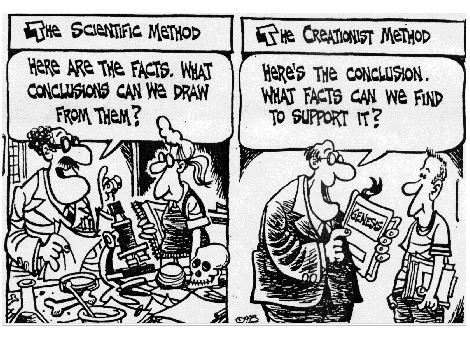
Yet according to fundamentalists like Phillip E. Johnson in his book Reason in the Balance, the case against Naturalism in science, law, and education, and other Christian fundamentalists, the child roasters and cat killers were correct after all and science has everything all wrong. Everything we know of modern science is wrong, as he hints at some evil atheist conspiracy to lock out God in the science community. His proof is simply the fact everything that happens isn't contributed to some supernatural theme as opposed to it just happened.

As fundamentalist religion and New Age mysticism consume millions, our nation is falling into a bottomless pit of mediocrity and irrational thought that dominated the Europe for over 1000 years. The fact is that many people just don't have the knowledge to understand what separates issues of faith and humanity from the natural world. What is worse, they don't want to know because they have withdrawn from reality.
...
Debunking Myth

Most people would be shocked to know that the ancient Greeks invented concepts of reason, modern science, modern history, and democracy 2500 years ago. They knew the world wasn't flat and even touched on evolution knowing the world wasn't 6000 years old. Even the church fathers such as St. Augustine and St. Thomas Aquinas figured out the earth was not only very old, but life also sprang from a common source.

Even more shocking to many people in America today is the gifts the Arabs would transmit to the modern world. They would not only preserve the great discoveries of the Greeks, but would greatly expand them. They would invent algebra (an Arabic word), and transmitted from India the base 10 number system (the concept of zero did away with the cumbersome Roman system), and expand science and math far beyond even Greece. Greek philosophy, destroyed or lost by the Catholic Church, would be brought back to light by contacts with Arabs in Spain. Arab writers in the 10th century even knew that mountains were formed by rain, wind, and land upheavals over a long period of time and figured out what Christian Europe rejected until the age of Charles Darwin.

The Christian churches knew of all of this, but rejected them for political reasons and mindless dogma.
...
So what is the problem with Johnson and other fundamentalists? To quote Johnson himself, "Rational beliefs are those that are consonant with reality." (P, 10) Because science doesn't attribute everything to supernatural micro-management of God and leaves some elements to chance, he feels it undermines the Bible. Sorry, science works on reason and verifiable proof, not revelation. The other fact is science/reason actually produces results, something the claims of magic have always failed to do. Science at the same time doesn't address the matter of God at all. It comes down to a literal Genesis and the Adam/Eve story and original sin, which Jesus never mentioned, but was created by the Apostle Paul.

How revealed religions such as Christianity, Judaism, and Islam derive truth is by divine revelation. That is direct communication either directly from God via voices visions, etc. or by angels and other divine massager. All we have is the word of the founder, because Christians (as an example) claim angels can't be seen. This revealed "truth" can't be disputed and all other ideas must be derived from it. So anything "observed" must be seen in the light of revelation. To quote Tertullian of Carthage: (150-225) "Divine revelation, not reason, is the source of all truth."

Phillip Johnson is a law professor and lawyer and knows little about the workings of science. Science is based on naturalism and thus deals only with what can be observed. Johnson considers naturalism a religion. (He uses other terms such as modernism and liberal rationalism, etc.) As a lawyer he plays a deceptive game of words mixing liberalism, rationalism, etc. then claims they have no relation to nature. (Which he says is God) What he really object to is a marginal treatment of Christianity; "the establishment of a particular religious philosophy does not imply competing philosophies are outlawed, but rather they are relegated to a marginal position in private life"

On a California textbook policy change, "this policy encouraged textbook publishers and teachers to give much greater emphasis to accepted scientific doctrines and to relegate any consideration of nonscientific subjects such as divine creation, ultimate purpose, and the ultimate cause of the physical universe to literature and social studies classes." (P. 40-43)

Science does not deal in questions of God or ultimate purpose to begin with. Even he admits these are nonscientific subjects, thus they don't have any place in the science classroom. The facts are only 5% of the population is atheist, 95% believe in God. Over half believe in evolution as fact, but over 80% of those believe in theistic evolution or evolution as the work of God. What they don't buy is his particular Protestant Evangelical religion. To Johnson and other fundamentalists, he is in a cosmic battle of good and evil. There is no in between and he means literal six-day Creationism and a historical Adam.
...
What is more important is Darwin never invented any "Theory of Evolution." He promoted the hypothesis (oh, that word again!) that species evolved by random mutation and random chance. Modern science provided the proof he was basically right and thus it accepted by many as fact today. The "fit" would survive by some natural advantage and the least fit wouldn't. Does that mean if the bubonic plaque wiped out the human race that the decease was more intelligent (fit) than man? Of coarse not, that is an element of chance.

Today most scientists know evolution works within known parameters but there is also an element of chance as well. Darwin did not use fossils or radioisotope dating (radioactivity would be discovered in the 1890's after his death) nor did Darwin ever apply natural selection to civilized human beings. To quote Darwin himself: "Under civilized conditions the social and cooperative virtues were useful characteristics assisting in survival, so that we may expect that virtuous habits will grow stronger, perhaps becoming fixed by inheritance."

And evolution doesn't deal any deathblow to Christianity because most reasonable Christians (excludes fundamentalists) see the Old Testament as symbolic and reject Mosaic Law as done away with Jesus. I know several very strong church-going Christians who have no problem with evolution. Many fundamentalists today follow a cult known as Christian Reconstructionism that does away with Jesus (they refer to Jesus/Jews and their God as Satan) and prefer the Old Testament as the Law and themselves as the new chosen people. Followers of Jesus who actually believe in Him have no problem with evolution.

What really upsets many people is uncertainty, that the universe isn't really an orderly, predictable thing. Yes it is orderly within certain points; such as gravity will make a bowling ball dropped on one's foot painful. One could simply never bowl again or go near a bowling alley and be fairly assured that a bowling ball won't fall on their foot. If a meteor the size of a bowling ball hits you in the head, you are dead; there was no way to prevent it. That is random chance.

Life in reality is both, 50% random chance beyond our control, and 50% what we make it. Genetics plays the biggest part of all in cancer, so those who eat only brown, organically grown rice may die of cancer as easily as anyone may. One knows that not smoking tobacco lessons the chance one may get lung cancer, but sometimes we still can. Our choices in life only change the odds, but in the end we all die, nobody knows for sure beyond that.

I don't believe in modernism which says everything is relative and there is no right or wrong. Humans have intelligence and are not animals vulnerable completely to the whims of nature. To quote Einstein himself, "I shall never believe God plays dice with the world." We can make choices if we can separate what is certainly and stop wasting our time chasing phantoms. God gave us the ability to make choices for good or evil.

Life is uncertain as social, technical, and economic changes are a fact in today's world. Many people refuse to, or just can't handle the world around them, so they turn inward. In America this is made worse by an appalling education system that leaves millions in confusion unable to separate science from science fiction and religious faith from blind superstition and mysticism. All of this confusion limits many choices one could make.

Mr. Johnson's entire 245-page book never mentioned anything Jesus ever said, just his own frustration with the world. He wants his version of a spiritual world to be physical reality. Jesus clearly separates the spiritual from the physical world and is right on this matter as are many church fathers. I don't think these people believe what they preach, because if they did they wouldn't care what others think, and would be happy with life. The happy Christians, the ones who actually follow Jesus, who live as He says to live, aren't screaming at the world from the pulpit. I salute them.

The problem with fundamentalists like Mr. Johnson is we live in a technical and diverse world and they just can't handle it. Nobody tells any Christian in this country how to pray, when and where to go church, or what to believe. Nobody! They preach politics, power, and money, not God. If they want to remain ignorant and uneducated, that is their choice. If they refuse to read the Bible and substitute their own self-revelations and political nonsense over the words of even conservative Christian scholars, they are free to do so. If Mr. Johnson wants to write a book claiming some unfounded garbage that the science community is conspiring to destroy Jesus, he is free to do so. (I bought his book, which I'm certainly free to do.)

If these fundamentalists want to attack even their fellow Christians because they don't see the same flat, 6000-year-old earth they see, that's fine. If they choose to be beyond reason and live in some fantasy world, it is their choice.

But they can't force the rest of us to follow them or meddle in the personal lives of other people. I've been in the scientific and technical fields for over 25 years and the fundamentalists leave us only two choices: believe in their flat-earth world or atheism. They drive millions out of the Christian community and often into irrational New Age religion. There is a third choice.

Get an education and read the Bible for yourself. I'm glad I did or I'd be an atheist! Stops adding in things that are not there! The recent Y2K fiasco was the work of fundamentalists Christians (along with New Age technophobes) who thought they knew more than the Bible did. These people are preaching politics, not Jesus. The Bible is not a science book or was not meant as a history book.

The earth is not 6000 years old, evolution is accepted scientific fact, and the Bible isn't threatened by it at all if properly studied and considered. Most of all allow an element of reason into these discussions and stop hunting for Satan under every rock. Finally, if being a Christian produces only anger and resentment of others, go find a new church. There are plenty of good Christian churches around that don't act like cults or endlessly attack everything they don't understand or refuse to deal with. It is up to you!

(Read more: Here).

Genesis And Theistic Evolution: Part 1

One of my friends mentioned a Phillip Johnson book that dissects evolution just as most Fundamentalist do---needless to say the book sounds interesting despite Dr. Johnson's crackpot theories:
Johnson has advocated strongly in the public and political spheres for the teaching of intelligent design in favor of evolution, which Johnson characterizes as "atheistic" and "falsified by all of the evidence" and whose "logic is terrible". In portraying the philosophy of science, and by extension its theories such as evolution as atheistic...
---
[edit] Neocreationism
See also: Neocreationism
When asked how best to raise doubts and question evolution with non-believers, Johnson responded:
What I am not doing is bringing the Bible into the university and saying, "We should believe this." Bringing the Bible into question works very well when you are talking to a Bible-believing audience. But it is a disastrous thing to do when you are talking, as I am constantly, to a world of people for whom the fact that something is in the Bible is a reason for not believing it... You see, if they thought they had good evidence for something, and then they saw it in the Bible, they would begin to doubt. That is what has to be kept out of the argument if you are going to do what I to do, which is to focus on the defects in [the evolutionists'] case—the bad logic, the bad science, the bad reasoning, and the bad evidence.[32]

Allegations of limiting academic freedom
In 2006 Nancey Murphy, a religious scholar at Fuller Theological Seminary‎, claimed she faced a campaign to get her fired after she expressed her view that intelligent design was not only poor theology, but "so stupid, I don't want to give them my time." Murphy, who accepts the validity of evolution, said that Johnson called a trustee in an attempt to get her fired. Johnson admits calling the trustee, but denies any responsibility for action taken against her.[39]
[edit] AIDS denialism
Johnson is involved in AIDS denialism, which challenges the scientific consensus that HIV is the cause of AIDS.[40][41][42] He has written five articles about the subject.[43] The scientific community consider the AIDS denialist arguments to rely on cherry-picking of scientific data[44] as denialists selectively ignore evidence of HIV's role in AIDS. Denialism is thought to endanger public health by dissuading people from utilizing proven treatments.[45][46] In the Washington University Law Quarterly, critics Matthew J. Brauer, Barbara Forrest, and Steven G. Gey criticized Johnson and DI fellow Jonathan Wells for denying the AIDS/HIV connection and promoting denialism without any scientific support.[47] Specifically, they were criticized for signing a petition, which gains publicity rather than deal with the science.[47]


Anyways here are some of my thoughts on the subject:
First, Genesis is not a textbook on history, science and biology, but a spiritual and theological text. Personally, I read Genesis as a "mythic truth"---to me, it's a spiritual narrative, which speaks of God being the beginning of all things as Genesis 1:1 in the Hebrew states: אֱלֹהִ֑ים ‏בְּרֵאשִׁ֖ית בָּרָ֣א (berashit bera Elohim), which literally means: "in the beginning of God's or the gods' creating." God is still creating---in other words God is still overseeing evolutionary processes. See also: The Myths of Genesis for an interesting explanation of mythic truth. Anyways to me the narrative of Adam and Eve were superimposed onto a framework of the earlier existing Near Eastern creation myths by the scribes of "the Elohist tradition who referred to God as Elohim, which was derived from the name of the Canaanite God El (generally translated as "God" in English)." One such Near Eastern creation myth was the Enuma Elish part of which the Genesis creation accounts depend on:
Relationship with the Hebrew Bible
The dependence of at least part of the creation accounts found in Genesis on a common ancient Near Eastern "creation-by-combat" myth are "not gainsayable."[2] The ancient Mesopotamians believed that the world was a flat circular disc surrounded by a saltwater sea. The habitable earth was a single giant continent inside this sea, and floated on a second sea, the freshwater apsu, which supplied the water in springs, wells and rivers and was connected with the saltwater sea. The sky was a solid disk above the earth, curved to touch the earth at its rim, with the heavens of the gods above. So far as can be deduced from clues in the bible, the ancient Hebrew geography was identical with that of the Babylonians: a flat circular earth floating above a freshwater sea, surrounded by a saltwater sea, with a solid sky-dome (raqia, the "firmament") above. It is the creation of this world which Enuma Elish and Genesis 1 describe.[3][4] Comparisons between the Bible and other ancient Near Eastern texts are often obscured by English translations, which impose on the Hebrew the Christian doctrines of creation ex nihilo (out of nothing) and of the Trinity. Thus the opening of Genesis 1 is traditionally rendered: "In the beginning God created both Heaven and Earth...", whereas the Hebrew makes it clear that Genesis 1:1-3 is describing the state of chaos immediately prior to God's creation:[5] In the beginning of God's creating the skies and the earth, when the earth had been shapeless and formless, and darkness was upon the face of the deep, and God's spirit was hovering on the face of the water, God said, 'Let there be light!'[6] In both Enuma Elish and Genesis, creation is an act of divine speech—the Enuma Elish describes pre-creation as a time "when above, the heavens had not been named, and below the earth had not been called by name", while in Genesis each act of divine creation is introduced with the formula: "And God said, let there be...". The sequence of creation is identical: light, firmament, dry land, luminaries, and man. In both Enuma Elish and Genesis the primordial world is formless and empty (the tohu wa bohu of Genesis 1:2), the only existing thing the watery abyss which exists prior to creation (Tiamat in the Enuma Elish, tehom, the "deep", a linguistic cognate of tiamat, in Genesis 1:2). In both, the firmament, conceived as a solid inverted bowl, is created in the midst of the primeval waters to separate the heavens from the earth (Genesis 1:6–7, Enuma Elish 4:137–40). Day and night precede the creation of the luminous bodies (Gen. 1:5, 8, 13, and 14ff.; Enuma Elish 1:38), whose function is to yield light and regulate time (Gen. 1:14; Enuma Elish 5:12–13). In Enuma Elish, the gods consult before creating man (Enuma Elish 6:4), while Genesis has: "Let us make man in our own image..." (Genesis 1:26) – and in both, the creation of man is followed by divine rest. "Thus, it appears that the so-called Priestly Source account echoes this earlier Mesopotamian story of creation."
------------------------------
Other similarities:
What is Enuma Elish about? It is not primarily a creation story: very little of the content is about creation. Also, much more important than the creation of humans is the creation of the gods: theogony. The vast majority of the content is praising the attributes and deeds of Marduk, and his establishment as the chief god with his temple at Babylon. It is not too difficult to discern the purpose of Enuma Elish:

(1) to establish Marduk’s supremacy as the head of the Babylonian pantheon.

(2) to establish Babylon’s preeminence over all the cities in the country.

Although we have the epic attested only in its Babylonian form, it is obvious that the myth was originally Sumerian: most of the names besides Marduk are Sumerian rather than Semitic names. The Babylonians inherited the gods of the Sumerians, with Enlil (the god of earth) generally as the chief god. In the 18th c. BCE, Hammurabi (1792-1750) not only produced a very influential code of laws, but also effected a religious reform by asserting that Marduk was the chief god. The city of Babylon also rose to prominence during this period (first Babylonian dynasty, 1894-1595).

ENKI AND NINHURSAG: A PARADISE MYTH
(ANET 37-41)

The story takes place in Dilmun, a pure paradise where there is no sickness or death, “the lion kills not, the wolf snatches not the lamb,” etc. Enki (=Ea), the god of the wisdom and the sweet waters that bring life to the land, impregnates the goddess Ninhursag (=Nintu), the “mother of the earth”. She gives birth to the goddess Ninmu. Enki impregnates his daughter Ninmu, giving birth to Ninkurra. Enki impregnates his granddaughter Ninkurra, giving birth to Uttu. Before Enki can lay his hands on his great-granddaughter, Ninhursag advises her to reject Enki unless he brings a gift of fruit. Enki comes with fruit, she happily receives him, but instead of producing a child, she uses his semen to produce 8 different plants. Enki eats these, infuriating Ninhursag. She curses Enki, vowing never again to look upon him with the “eye of life.” Enki apparently begins to deteriorate and the Anunnaki, the Sumerian gods of the underworld mourn, and in the end Ninhursag is brought back to the gods.
Similarities to Genesis 1-3:

-seduction with fruit

-the eating of trees brings a curse consisting of the withholding of life


GILGAMESH AND THE HULUPPU-TREE
(S. N. Kramer, Gilgamesh and the Huluppu-Tree, Chicago, 1938; cf. S. N. Kramer, Sumerian Mythology, 1944, 30f.). The second half of this myth is appended to the Gilgamesh epic in Tablet 12.

Heaven and earth are separated, humans are brought into being, Anu and Enlil choose heaven and earth respectively for their realms, Ereshkigal has been given the underworld, and Enki has headed for the watery abyss beneath the earth. A tree planted by the bank of the Euphrates river was blown down by the wind and floated away on the river. Inanna (=Ishtar), the queen of heaven sees the tree and takes it home to her “holy garden” where she transplants it and tends it, hoping that when it is grown she can make a bed and a chair out of it. But when it is grown, she is prevented from using it because a serpent has made its home at the root of the tree, the Zû-bird has made a nest in the top of the tree, and the demon Lilith has made her house in the middle of the tree. Gilgamesh saves the day by killing the serpent with his ax, also frightening off both Lilith and the bird family. Gilgamesh cuts down the tree and gives it to Inanna for her bed and chair. Inanna makes two objects out of the tree—pukku from the roots and mikku from the crown—and gives them to Gilgamesh. One day these gifts fall into the underworld, and Gilgamesh is distressed not to be able to recover them. His companion Enkidu goes to rescue them, but is prevented from returning to the living. His spirit gives Gilgamesh a report on what the afterlife is like.

Similarities to Genesis:

-tree with serpent (combined with demon)


See also: Creation myth for various other Creation myths. The Jews were certainly aware of the other Creation myths of surrounding cultures and they had lots to borrow from---however, there are differences between the Judeo-Christian Creation myth as well. Genesis is also a subversive myth:
Paganism and biblical ‘subversion’

So what is the purpose of this portion of Scripture - the first chapter of Genesis - according to biblical historians? In a nutshell, the opening section of the Bible appears to have been written to provide a picture of physical and social reality that debunks the views held by pagan cultures of the time. In short, Genesis 1 is a piece of subversive theology.
Genesis 1 appears to have been written to debunk the views held by pagan cultures of the time

To anyone familiar with the Old Testament this subversive, anti-pagan intent will come as no surprise. One of the golden threads of the Old Testament is its sustained critique of the pagan religions of Israel’s neighbours - the Egyptians, Canaanites and Babylonians. The first two of the Ten Commandments, for instance, are all about shunning the pagan deities of the ancient world. Moreover, the book of Psalms - the hymnbook of ancient Jews - regularly and explicitly declares that the creation owes its existence not to the pagan gods but to Yahweh, the God of Israel. In Jeremiah 50:2 the Babylonian creator god, Marduk, is explicitly named and denounced.
Given the prominence of this motif in the Old Testament it would be surprising if the Old Testament’s longest statement about creation did not take a swipe at pagan understandings of the universe. We do not have to speculate about this. Through a stroke of very good fortune, scholars are now able to see just how the writer of Genesis went about his task of debunking his ancient rivals.


See also: Genesis: The Origin of Revolution. I shall continue this discussion in a subsequent post.