Showing posts with label baptist distinctives. Show all posts

Tuesday, February 23, 2010

Baptist Diseases


Courtesy of Pastor I. Todyaso and his band of discerners.

It's funny though clearly whoever wrote the accompanying article doesn't understand what being a Baptist is all about as not all Baptists are alike. Here are the main distinctives that all Baptists hold in common in some form or fashion:

One way of classifying Baptist Distinctives is called the "Four Freedoms," articulated by Baptist historian Walter B. Shurden:[1]

Soul freedom: the soul is competent before God, and capable of making decisions in matters of faith without coercion or compulsion by any larger religious or civil body
Church freedom: freedom of the local church from outside interference, whether government or civilian (subject only to the law where it does not interfere with the religious teachings and practices of the church)
Bible freedom: the individual is free to interpret the Bible for himself or herself, using the best tools of scholarship and biblical study available to the individual
Religious freedom: the individual is free to choose whether to practice their religion, another religion, or no religion; Separation of church and state is often called the "civil corollary" of religious freedom


Or in another form:

[edit] "B-A-P-T-I-S-T-S" acrostic
Another popular list of beliefs shared by most Baptist traditions is expressed in the form of the following acrostic backronym, spelling BAPTISTS:[2]

Biblical authority (Matthew 24:35; 1 Peter 1:23; 2 Timothy 3:16-17)
Autonomy of the local church (Matthew 18:15–17; 1 Corinthians 6:1-3)
Priesthood of all believers (1 Peter 2:5-9; 1 Timothy 5)
Two ordinances (believer's baptism and the Lord's Supper) (Acts 2:41–47; 1 Corinthians 11:23-32)
Individual soul liberty (Romans 14:5–12)
Saved church membership (Matthew 16:18; Ephesians 5:23–32; Colossians 1:18)
Two offices of the church (pastor and deacon) (1 Timothy 3:1-13; Titus 1–2)
Separation of Church and State (Matthew 22:15–22)


While Baptists for the most part are Credobaptists not all Baptists are closed-Baptists. The SBC of course are closed off to Credobaptism as being the only valid mode of baptism but remember it's not really the mode of baptism that's really the most important thing but the confession that Jesus is one's Lord before or after baptism at some point. The confession is the most important part because whereas faith is individualistic to some degree; it's meant to be lived out in a communal setting in other words the church. The Baptist tent is big enough to embrace both those who practice Credobaptism and Paedobaptism. In fact, most Moderate Baptist churches accept both Credobaptism and Paedobaptism as valid modes of baptism for the sake of our former Catholic, Lutheran and Presbyterian brothers and sisters who join our fellowship and come into the Baptist fold. What are your thoughts on the subject?

Friday, January 15, 2010

Al Mohler And Tony Cartledge: Heresy And Heroism

In a recent Blog post Al Mohler critiques an article by Tony Cartledge on Crawford H. Toy and famous Baptist missionary Lottie Moon. Dr. Mohler's Blog post is entitled "Heresy is Not Heroic — Is Crawford Howell Toy a Baptist Hero?" Of course to Dr. Mohler the answer is no because "doctrinal purity" is more important than whether someone lives a Christ-like life or not so there is no surprise there.

All Baptists admire Lottie Moon---it is ingrained within our upbringing from when we are younger sending money to Lottie Moon mission offerings. However most do not know the story of Crawford Howell Toy who was engaged to Lottie Moon. However because Toy championed biblical criticism over the absurd belief in biblical inerrancy. It has been rumored that he and Lottie Moon broke their engagement off because of his "theologically liberal" beliefs.

Indeed Crawford Toy is a Baptist hero of faith because of his commitment to intellectually living out his faith in the same way that Lottie Moon lived out hers on the mission field. Despite the fact that Toy later became a Unitarian, he should be celebrated for his contributions to Baptist life because he was not afraid to stand upon the traditional Baptist principles of soul competency, liberty of conscious and the right to dissent---despite the pressures of the "status quo."

Anyways here are some of the more critical parts of Dr. Mohler's post:
The most troubling section of Cartledge’s article has little to do with Lottie Moon, however. After stating his admiration for Lottie Moon’s “willingness to suffer deprivation because of her devotion to Christ and to missions,” Cartledge then states, “Increasingly, I have also come to admire Crawford Toy, who was no less devoted to Christ, and was willing to suffer rejection by Southern Baptists rather than surrender to the narrow-minded demand that he forgo scholarship and limit his teaching to popularly accepted notions.”

The admiration of liberal Baptists for Crawford Howell Toy should be a matter of both amazement and genuine concern. It is also a telling indication of how many of those identified as “moderates” in the Southern Baptist Convention controversy actually view the Bible. To celebrate Toy is to celebrate his beliefs about the Bible. Those beliefs were not heroic.

Neither is biblical inerrancy and elevating the bible as an idol heroic.
.........................

As later became clear, Toy drank deeply from the wells of theological liberalism and Biblical criticism during his years in Germany.

In his inaugural address as a professor at Southern Seminary, Toy argued that the Bible has both a human and a divine element. As his theological pilgrimage revealed, Toy would use this hermeneutical distinction in order to argue that the Bible contains nothing but truth in its divine element, even as its human element shows all the marks of human fallibility. The human element contains both errors and myths, but the Bible’s “religious thought is independent of this outward form.”

Because the bible indeed contains elements of "Mythic Truths" as well as downright absurdities that are in error---however, the bible is divinely inspired despite being the product of fallible human hands. After-all, it was sinful humans who did the actual writing and compiling of the bible.

..........................

Nevertheless, Toy’s theological trajectory did indeed take him not only out of the Southern Baptist fellowship, but out of the Christian faith altogether. During his time at Harvard, Toy eventually became a Unitarian — a faith that denies the deity of Christ and the doctrine of the Trinity. He also accepted an evolutionary understanding of religion which accepted religion as a purely natural phenomenon.

In other words, Toy became what Christians throughout all the centuries of church history and in all the major traditions of the Christian Church would rightly identify as a heretic. He abandoned faith in the deity of Christ and abandoned the Christian faith. Yet, moderates in the SBC controversy often celebrated Crawford Toy as a hero and as a theological martyr for academic scholarship. Tony Cartledge continues this tradition by expressing his admiration for Crawford Toy, going so far as to claim that he “was no less devoted to Christ” than Lottie Moon. “There’s more than one way to be a hero,” Cartledge concluded.

I can only hope that Tony Cartledge either does not understand or does not mean what he writes in this article. To declare Crawford Toy and Lottie Moon to be equally devoted to Christ defies both common sense and theological sanity.

Idolatry of the bible is theological insanity.

As Old Testament scholar Paul House, now of the Beeson Divinity School, has argued, the roots of Toy’s later heresies were found in the presuppositions of his hermeneutic as he set forth his thought in his inaugural address at Southern Seminary. House does not question Toy’s personal integrity, noting his honesty in presenting his own beliefs. Toy himself recognized that his beliefs changed even during the years he taught at Southern Seminary. The key issue is that Toy’s understanding of the Bible left him completely vulnerable to every heresy and doctrinal aberration. Broadus rightly warned Toy of this danger at the time of his resignation.

Fundamentalism is a heresy and doctrinal aberration.


We should grieve the example of Crawford Howell Toy and learn from it, even as we are inspired by the courageous and Gospel-centered witness of Lottie Moon. The story of Crawford Howell Toy contains a cautionary message for every Christian teacher, seminary, church, and denomination. The elevation of Crawford Toy to the status of a hero alongside one of Christianity’s most famous Gospel missionaries is both tragic and scandalous. Heresy is not heroic.

Fundamentalism is what's not heroic.

Tuesday, September 22, 2009

Southern Baptist Robin Foster On Simply Being Baptist

Here is a good quote from Robin Foster from SBC Today:
I am a Baptist, pure and simple in the historical and biblical sense. I believe being a “good” Baptist means we are to be people of the book and that the truest form of a New Testament local church is a visible group of regenerate Christians who covenant together to practice believers baptism by immersion, carrying out the two ordinances of the church: baptism and the Lord’s Supper (participants are to be saved and properly baptized), organized under a congregational system of polity, submitting to the Lordship of Christ, and propagating the gospel to the lost. As a “good” Baptist, one should uphold the doctrines of inerrancy, priesthood of all believers, and soul competency. Now, in a biblical sense, there is no one “good” but God. I am only borrowing the language used by both speakers, but also in a biblical sense I am under the strong belief that these doctrinal stands, working together, identify us as Baptists. I again revisit the question, “Why can’t we all identify ourselves as Baptists and be free to be a Calvinist or a non-Calvinist?” Why does identifying with Calvinism make one a better Baptist than a non-Calvinist? The answer, it doesn’t. Both groups have been instrumental in passing on a rich heritage to us. To classify us into a hierarchy based on our understanding of soteriology creates nothing but worldly division. Again, for all including those who distort Calvinism as the dreaded death knell to Southern Baptists, let’s be Baptist and be free to choose how we define our soteriology.

I would prefer to be known as a Baptist pastor who diligently searches the scriptures for God’s wisdom, shepherds the flock for which I have been given responsibility, and tells others about the love of Jesus for them. Pure and simple.


Might I add an amen---now if the rest of the SBC would follow suit maybe they could get back to the basics of being Baptist. A return to Liberty Of Conscience and Soul Freedom---the traditional Baptist virtues for starters would allow the freedom for one "to be Baptist and be free to choose how (they) define (their) soteriology" rather than blind creedalism. Even better---putting Christ at the center and as the main point of all things will eradicate "the worldly divisions" within the Body of Christ as a whole---for focusing on Christ and participating actively in His redemptive work eliminates the need to get caught up in the external trappings of religion and the non-essentials of faith.

Wednesday, June 3, 2009

Youth And Religion

Here's part of an interesting posting from Drew Tatusko:
teens are functionally illiterate when it comes to religion
Jun 3rd, 2009 by Drew Tatusko.

This can be classified as a major church FAIL. It is not that all teens are functionally illiterate, but most teens indeed are. They have not acquired and thus have not practiced using the tools to articulate their religion. This was a finding Christian Smith reports in the book Soul Searching where data from the National Study of Youth and Religion is presented. The following is worth quoting in full.

We do not believe that teenage inarticulacy about religious matters reflects any general teen incapacity to think and speak well. Many of the youth we interviewed were quite conversant when it came to their views on salient issues in their lives about which they had been educated and had practice discussing, such as the dangers of drug abuse and STD's. Rather, our impression as interviewers was that many teenagers could not articulate matters of faith becuase they have not been effectively educated in and provided opportunities to practice talking about their faith. Indeed, it was our distinct sense that for many of the teens we interviewed, our interview was the first time that any adult had ever asked them what they believed and how it mattered in their life…Religious language is like any other language: to learn how to speak it, one needs first to listen to native speakers using it a lot, and then one needs plenty of practice at speaking it oneself. Many U.S. teenagers, it appears, are not getting a significant amount of such exposure and practice and so are simply not learning the religious language of their faith traditions (p. 133).


....
How would you characterize the religious literacy of your youth, and your adults in church? And then, what are you going to do about it?


I wonder how much of this is related to our technology-driven culture and how much of it is related to churches failing to provide teenagers with the tools to articulate religious viewpoints. I know personally that I didn't know much about Baptist principles until minoring in Religion at Campbell University---even-though, I grew up in a Baptist church and have been in a Baptist church ever-since. I did know a little bit about Baptists before though and how we were different from other denominations. Mostly because my Scout troop was connected with a Presbyterian church---also, one Summer, when I was staying with my grandmother at the beach she enrolled me in a Presbyterian VBS to give me something to do. Also, in my Youth Group at FBC-Laurinburg, we had members who regularly attended a Methodist church. I also saw Pope John Paul II and Catholic services in Europe and I went to the blessing of a friend's family's new pastor’s house in the Anglican tradition, so I've always been aware to some degree of denominational differences. I'm not sure how denominational distinctions play in the National Study of Youth and Religion's findings, but it is true that different denominations as well as churches phrase religious matters differently. I also know that technology is useful for disseminating religious information though there are times when technology gets in the way.

See also: Al Mohler On Text Messaging and Technolatry.

As far as Drew's questions go: "How would you characterize the religious literacy of your youth, and your adults in church? And then, what are you going to do about it?" I'm not sure how best to answer the first question as FBC-Wilmington may be a Baptist church but a large number of our congregation grew up and moved their memberships from non-Baptist churches and since we are a large church with a congregation spread between two different services---we truly have a diverse and ecumenical group with various religious opinions in that respect. Also, our members have a wide range of religious knowledge and aptitudes, because of this fact. Hect, we even have a lot of retired pastors in our congregation. As far as the youth in our church goes, I'd say that they are about the same as our adults---but with all that said it is still hard to tell who is religiously literate or not---because of the sheer size of our church. In regards to the second question, because I am the Cooperative Baptist Fellowship of North Carolina co-advocate for FBC-Wilmington, I try my best to spread information where I can about Baptist religious principles while remaining denominationally neutral and ecumenical and always Christocentric.

Saturday, March 28, 2009

Our Eroding Baptist Principles

That Baptist Ain't Right asks: That Baptist Ain't Right: Baptists No Longer for Separation of Church & State? How did we get here?

Here is some of that post with hyperlinks inserted by me:
THURSDAY, MARCH 26, 2009
Baptists No Longer for Separation of Church & State? How did we get here?

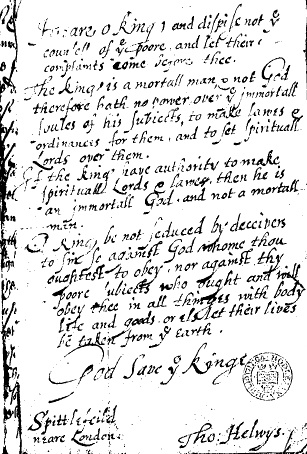
Waaaaay back in 1612, Thomas Helwys, the first Baptist, wrote The Mystery of Iniquity that outlined the basic ideas of what it is Baptists believe. Primary in that work was the concept of the separation of church & state, the theological concept that only God can judge a soul & therefore government should compel anyone to follow or support any faith. Helwys went so far as to sign his name to a note he penned on the inside cover specifically for King James. For his efforts, Helwys was promptly arrested & died in prison in 1616.

Helwys wasn't alone. Roger Williams. Isaac Backus. John Leland. All of the early Baptist in the America supported the concept of the separation of church & state. In fact, until around 1980, the overwhelming majority of Baptists supported the separation of church & state.

So how did we move from overwhelming support for the separation of church & state, to the near unanimous approval of a Domionist ideology among Baptists in just 25 years?

I asked that question to Dr. Bruce Prescott back in November of 2007 & got an interesting answer. Paradoxically, the answer Dr. Prescott (the Baptist) gave is nearly identical to that a good friend of mine gave who happens to be Catholic. Odd.

After WW II, there was a surge in the effort of Catholic parochial schools to get gov't money. Obviously Protestants were opposed to their tax money being used to support Catholic schools. In 1947 the Protestants and Other Americans United for Separation of Church and State was formed to oppose the funneling of tax money to Catholic schools. Religious & educational fought to make sure Catholics were given any preference & the Protestants were danged sure to not let Protestant tax money be used unwisely. And, thus, the religious leaders, particularly Baptist leaders, recited well the history of Baptist support for the separation of church & state.

But something happened. Baptists began to grow after WW II with lots & lots of babies. The suburbs grew. And racial tension came fast & furious.

The turning point, according to both Dr. Prescott & my friend who happens to be Catholic, was school integration.


I'd like to offer some additional insights to the problem. Another reason certain Baptists aren't standing up for the separation of church and state is because with the Fundamentalist Takeover of the SBC and the Religious Right's dominating influence on Southern Baptist life, eschatology began to shift toward a premillenial dispensationalist stripe. This coupled with the SBC's shift towards dogmatic theocratic Calvinism paved the way for the erosion of traditional Baptist principles. While it is true that premillenial dispensationalism in itself is anti-political, premillenial dispensationalists are ardent political Zionists. See also: "Left Behind" and the Corruption of Biblical Interpretation and Evangelicals and Israel: Theological Roots of a Political Alliance.

Also, Christian Reconstructionism's influence on the Religious Right plays a part in the problem. See also: Republican mastermind bemoans GOP+theocracy partnership. Anyways, because of these factors, we have Baptists as well as other fungelicals that mix theology and politics in a theocratic manner.

See also: TheoPoetic Musings: It's Time: Week 8---A Baptist Witness That Dissents On Manichaeistic Fundamentalism.

Monday, November 17, 2008

It's Time: Week 8---A Baptist Witness That Dissents On Manichaeistic Fundamentalism

Week 8 was suppose to be about Baptist heritage and Dr. Queen's sermon was of course, but in Sunday School, we had a bombardment of Anti-Baptist Neo-Manichaeistic Fundamentalist Dualism. I've never heard so much rampant Neo-Manichaeism in a church setting in person before except for a few times in small groups, maybe, but wow what antithetical Baptist thinking. Our teacher said one can't follow "secular" humanism and Christianity at the same time implying an us vs. them, absolute black and white, either/or mentality. I would like to know if he'd say that to the Reformers---most of whom followed in part some form of humanism blended with Christianity such as: Erasmus and one of my ancestors, George Buchanan. Anyways, here are some more thoughts on the Neo-Manichaeism of Fundamentalism:
First, here is the Fundamentalist Project's "definition of fundamentalism (which) has nine sections, five
related to the fundamentalist ideology, and four to the groups’ organization":
1) Reactivity to the marginalization of religion. Fundamentalist movements are “concerned first with the erosion of religion and its role in society”, and they therefore protect “some religious content, some set of traditional cosmological beliefs and associated norms of conduct”.#--- (#= This and the following quotations are from Gabriel A. Almond, Emmanuel Sivan and R. Scott Appleby, “Fundamentalism: Genus and Species”, in Martin E. Marty and R. Scott Appleby, eds., Fundamentalisms Comprehended, Chicago, The University of Chicago Press., 1995, pp. 399-424)
2) Selectivity. Fundamentalism is not merely defensive of the tradition, but “selects and reshapes aspects” of it, that differentiate fundamentalist ideology from the religious mainstream. Similarly, fundamentalists accept some sides of modernity (particularly its technological and organizational features), but refuse others (mainly the ideological
underpinnings of modernity, such as relativism, secularism, and pluralism), some of which are singled out “for special attention, usually in the form of focused opposition”.
3) Moral manicheism. The fundamentalist worldview considers reality to be “uncompromisingly divided into light [...] and darkness[...]. The world outside the group is therefore contaminated, sinful, doomed; the world inside is a pure and redeemed ‘remnant’”.
4) Absolutism and inerrancy. Fundamentalists share a belief in the inerrancy of their sacred texts, “or its analogues (e.g., papal infallibility, a privileged school of Islamic jurisprudence, etc.)”; with a recognizable approach to sacred sources, which opposes the hermeneutical methods.
5) Millennialism and messianism. In their view, history has a miraculous culmination, when “the good will triumph over evil”; and “the end of days, preceded by trials and tribulations, will be ushered in by the Messiah, the Savior; the Hidden Imam”.
6) Elect, chosen membership. The militants of the fundamentalist groups tend to consider their membership as “‘elect’, chosen, divinely called”.
7) Sharp boundaries. Among fundamentalist movements is widespread the idea of a separation between the faithful and the sinful, with the notion “of a dividing wall and other spatial metaphors”. The separation can be
physical, or “implemented through audiovisual boundaries, through a distinctive vocabulary, and through control over access to the media”.
8) Authoritarian organization. Although membership is voluntary, with frequent trends towards equalitarianism, “the typical form of fundamentalism organization is charismatic, a leader-follower relationship”. The tension between these two features makes movements sometimes fragile. Moreover, “since there can be no loyal opposition, there is a tendency toward fragmentation”.
9) Behavioral requirements. “The member’s time, space, and activity are a group resource, not an individual one”. In order to create “a powerful affective dimension, an imitative, conforming dimension”, groups thus have “distinctive music, [...] rules for dress [...] drinking, sexuality, appropriate speech, and the discipline of children”, with censorship of reading and audio-visual material.

How Right-Wing Conservatives are Manichaeistic:
Although the neo-conservatives are secular (and oftentimes quite liberal in their social outlook) and the religious right is theologically-based, these two currents share a number of ideas:

both currents are Manicheistic, i.e., they see the world in absolute black and white, good and evil;

both currents define the forces of good as being led by the U.S. and Israel and see the forces of evil (once defined as the Soviet Union and now see as "the axis of evil" states supporting terror) as including Arabs and Islam;

both currents are confrontational and uncompromising. They believe that there can be no accommodation made with those representing evil. Both, therefore, seek confrontation and conflict, not a resolution of tensions through negotiations; and

both currents are absolutist, since their ideology will allow only for total victory.


Also, Rich Mullins had this to say about the Manichaeism of Fundamentalism: "Everything is spiritual. Which is another hang-up I have with Protestantism, and even more specifically with Evangelicalism. It’s more like Manicheism than anything else. This dualistic system that says that everything physical is evil, and the only good things are spiritual things. And I go, ‘Wow! John wrote a good bit of what he wrote to counter that kind of thinking.’ And yet, all these Bible-believing, Bible-thumping born-again-ers are going around professing the very thing that John tried to put out." (Brendt Waters, interview with Rich Mullins, conducted in April 1996). See also: A Comparison between Manichean & Christian Views of Evil, Persian philosophy and Manichean Texts. Also, it is interesting how fundies always reduce everything to issues of sexuality and compromising morality---even issues, which aren’t sexual in nature are rooted in sexual rhetoric---ie. Sins of the flesh, flesh-nature, etc.---which is part of the reason Fundamentalism promotes a semi-docetic/Manichaean view of humanity.

Next we were told that "secular humanists" were trying to convince Christians that homophobia is wrong and abortion in any case is right and that we should always stand against homosexuality and abortion in all cases as well as pray for adulterers. First of all, it's anti-Baptist to coerce people in matters of conscience as freedom is one of the most cherished tenets of Baptist distinctives. Secondly, homosexuality is most certainly not wrong, but homophobia is even within a Christian context---see: Homosexuality . Thirdly, abortion is debatable as opinions within a Christian framework have changed over time. Consider Saint Thomas Aquinas who supported and defended abortion in every case---so for all the clamor of the Roman Catholic Church’s support and defense of an Absolute Unchanging Morality---Catholic theological opinions seemed to have changed over the years over this so called “Absolute Unchanging Morality.” (See Aquinas on human ensoulment for a counter argument). Also within an uncontextual literalistic and legalistic vacuum in which Fundamentalists read the bible, abortion is permissible as God decreed abortion as per these verses and God's decrees are eternal in a Traditional understanding of God's attributes:
Numbers 31:17
English Revised Version

Now therefore kill every male among the little ones, and kill every woman that hath known man by lying with him. (Murder of possible pregnant women= infanticide or feticide)

Hosea 13:16GOD'S WORD® Translation (©1995)
The people of Samaria are guilty as charged because they rebelled against their God. They will be killed in war, their children will be smashed to death, and their pregnant women will be ripped open. (abortion)

Psalm 137:9 (Douay-Rheims Bible)
Blessed be he that shall take and dash thy little ones against the rock. (infanticide)---for example.


See also: Why Abortion is Biblical ---my view is here: TheoPoetic Musings: A THEOLOGICAL DECLARATION AND 95 THESES FOR BAPTIST PROGRESSION. It is interesting to note how anti-abortionist Fundamentalists use Deuteronomy 5:16 to condemn abortion but support capital punishment and war. It's interesting how all the issues mentioned yesterday in Sunday School were sexual in nature, but no calls to stand against the capitalist materialism of Right-Wing Conservatives or to stand against war as Jesus and the Early Church did as for example:
Tatians(164)

You wish (to) make war, and you take Apollo as a counsellor of slaughter. You want to carry off a maiden by force, and you select a divinity to be your accomplice. You are ill by your own fault; and, as Agamemnon wished for ten councillors, so you wish to have gods with you. Some woman by drinking water gets into a frenzy, and loses her senses by the fumes of frankincense, and you say that she has the gift of prophecy. Apollo was a prognosticator and a teacher of soothsayers: in the matter of Daphne he deceived himself. An oak, forsooth, is oracular, and birds utter presages! And so you are inferior to animals and plants! It would surely be a fine thing for you to become a divining rod, or to assume the wings of a bird! He who makes you fond of money also foretells your getting rich; he who excites to seditions and wars also predicts victory in war. If you are superior to the passions, you will despise all worldly things. Do not abhor us who have made this attainment, but, repudiating the demons, follow the one God. "All things were made by Him, and without Him not one thing was made." If there is poison in natural productions, this has supervened through our sinfulness. I am able to show the perfect truth of these things; only do you hearken, and he who believes will understand. I do not want to be a king: I do not wish to be rich: I decline military service: I hate fornication. (Cadoux, pg 103)

Justin Martyr (d. 165)
writings (153‑160?) martyred

And when you hear that we look for a kingdom, you suppose, without making any inquiry, that we speak of a human kingdom; whereas we speak of that which is with God, as appears also from the confession of their faith made by those who are charged with being Christians, though they know that death is the punishment awarded to him who so confesses. For if we looked for a human kingdom, we should also deny our Christ, that we might not be slain; and we should strive to escape detection, that we might obtain what we expect. But since our thoughts are not fixed on the present, we are not concerned when men cut us off; since also death is a debt which must at all events be paid. (I Apology, 11) And when the Spirit of prophecy speaks as predicting things that are to come to pass, He speaks in this way: "For out of Zion shall go forth the law, and the word of the Lord from Jerusalem. And He shall judge among the nations, and shall rebuke many people; and they shall beat their swords into ploughshares, and their spears into pruning‑hooks: nation shall not lift up sword against nation, neither shall they learn war any more." And that it did so come to pass, we can convince you. For from Jerusalem there went out into the world, men, twelve in number, and these illiterate, of no ability in speaking: but by the power of God they proclaimed to every race of men that they were sent by Christ to teach to all the word of God; and we who formerly used to murder one another do not only now refrain from making war upon our enemies, but also, that we may not lie nor deceive our examiners, willingly die confessing Christ.

And:
Athenagoras
'Legatio pro Christianis & De Resurrectione (177‑180)

For the robber, or ruler, or tyrant, who has unjustly put to death myriads on myriads, could not by one death make restitution for these deeds; and the man who holds no true opinion concerning God, but lives in all outrage and blasphemy, despises divine things, breaks the laws, commits outrage against boys and women alike, razes cities unjustly, burns houses with their inhabitants, and devastates a country, and at the same time destroys inhabitants of cities and peoples, and even an entire nation‑‑how in a mortal body could he endure a penalty adequate to these crimes, since death prevents the deserved punishment, and the mortal nature does not suffice for any single one of his deeds? It is proved, therefore, that neither in the present life is there a judgment according to men's deserts, nor after death. (The Resurrection of the dead, 19) How, then, when we do not even look on, lest we should contract guilt and pollution, can we put people to death? And when we say that those women who use drugs to bring on abortion commit murder, and will have to give an account to God s for the abortion, on what principle should we commit murder? For it does not belong to the same person to regard the very foetus in the womb as a created being, and therefore an object of God's care, and when it has passed into life, to kill it. (A Plea for the Christians, 35)


Anyways as a Baptist, I should have dissented on the opinions professed in Sunday School yesterday, so here I just did.

Monday, October 27, 2008

I've Tried To Keep Politics Off Of Here...

But this is too rich:

Dr. James Dobson, of Focus on the Family has published a letter trying to "scare" Christians into voting for John McCain. It is a fictional letter written by a Christian in 2012, four years after Obama is elected. Frankly, it is one of the most offensive things that I have ever read. I believe that it important for Christians not to be scared or bullied into voting one way or another. I'm tired of hearing people say that McCain is the way Christians need to vote, hearing about how pastors have said it is "unchristian" for people to vote for Obama, and seeing Church signs pushing their parishioners one way or another.

Read more from my friend Christina Whitehouse-Suggs' Livejournal.


Read Dobson's actual letter: Here.

Here is Christina's letter of response:

Dear Dr. Dobson,

I am so very tired of your ranting about politics and theology, claiming that all good Christians agree with your views. Your most recent fictional letter is yet another brick in the fundamentalist wall you continue to build around your narrow-minded kingdom. I'm sure others are saying they are appalled and outraged at your sensationalist tactics, but I'm far past that. For years you have not shown yourself to be concerned with anything that lines up with the message of the risen Christ.

If you truly consider yourself a follower of the Jesus portrayed in the Gospels, then you need to write a letter of apology to Senator Obama, as well as the entire Democratic party. Your work of fiction is the most vilifying piece of trash I've read since the Left Behind series. As Christians, we should be active in the political process but never stoop to such low-handed, strong-armed tactics.

Rev. Christina Whitehouse-Suggs


I must say I actually agree with Christina's letter moreso than Dr. Dobson's eventhough I may be a registered Republican (though I don't support either party). However, being thoroughly Baptist---I respect Dobson's right to believe as he chooses, but I believe Dobson went too far here. Especially, since coercive faith is against basic, fundamental and standard Baptist principles or as Roger Williams would say: “forc’t Worshipp stincks in Gods nostrils.”

Write your own response letter: Here.

Wednesday, September 17, 2008

08-08-08 At 8 P.M.: My Cousin's Wedding


Rain And Amanda's Ceremony

So my cousin, Rain, is a lesbian, so many have falsely believed that my views on the same sex marriage issue are because of that fact---but nothing can be further from the truth. Before I get to that, I have to say that their ceremony was short and sweet and performed by a Unitarian Universalist minister. Though I've known about Unitarian Universalism---that was my first experience with something like that, so it was interesting. I must say I can respect Unitarian Universalists, even if our beliefs differ.

(I gotta rep Bill, my aunt's boyfriend here, since I haven't mentioned him yet---he took most of the photos of the ceremony). Much to the chagrin of my homophobic minded friends, I gave Rain and Amanda these books as gifts: a New Testament geared to gays and a Bible study for gays. Oh, and they chose 08-08-08 at 8 P.M. as the date to be joined, because they've been together for 8 years.

---------------------------------------------------------------------------------

Anyways to get to my views: I have always believed that Baptist churches had the right to decide for themselves how to view things, so when I was pressed to defend my brother's beliefs (who is even more liberal than me on most things)---I reread all of the Baptists distinctives: soul liberty, liberty of conscience, freedom and church autonomy, etc. The Baptist distinctives then are where my views fit into the Baptist Tradition.

Other than that: issues of Biblical translation, historical issues and scientific findings are also part of my understanding of the issue. Although, I can agree with Conservatives that homosexuality was not God's original intent, but the traditional answers do not do the issue justice as it doesn't explain: intersexuality, Mermaid Syndrome, human cloacae, aphallia, which "is considered a substantially more troublesome problem in a male, and has in the past sometimes been considered justification for assigning and rearing a genetically male infant as a girl" and a number of other congenital malformations.

Also, my mom believes that homosexuality is God's answer to the problem of overpopulation. Either way, it is neither right nor just to deny love to God-fearing adults as true love never is a sin. The same-sex issue is unlikely to go away anytime soon, but it is the new civil rights movement. Facebook users can view my friend (who went to Campbell with me) Micah's note or you (everyone) can view the church he pastors for further relevant information.