Showing posts with label thomas helwys. Show all posts

Saturday, March 28, 2009

Our Eroding Baptist Principles

That Baptist Ain't Right asks: That Baptist Ain't Right: Baptists No Longer for Separation of Church & State? How did we get here?

Here is some of that post with hyperlinks inserted by me:
THURSDAY, MARCH 26, 2009
Baptists No Longer for Separation of Church & State? How did we get here?

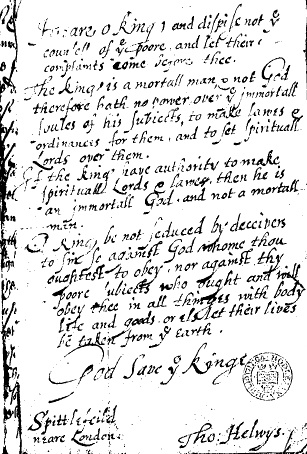
Waaaaay back in 1612, Thomas Helwys, the first Baptist, wrote The Mystery of Iniquity that outlined the basic ideas of what it is Baptists believe. Primary in that work was the concept of the separation of church & state, the theological concept that only God can judge a soul & therefore government should compel anyone to follow or support any faith. Helwys went so far as to sign his name to a note he penned on the inside cover specifically for King James. For his efforts, Helwys was promptly arrested & died in prison in 1616.

Helwys wasn't alone. Roger Williams. Isaac Backus. John Leland. All of the early Baptist in the America supported the concept of the separation of church & state. In fact, until around 1980, the overwhelming majority of Baptists supported the separation of church & state.

So how did we move from overwhelming support for the separation of church & state, to the near unanimous approval of a Domionist ideology among Baptists in just 25 years?

I asked that question to Dr. Bruce Prescott back in November of 2007 & got an interesting answer. Paradoxically, the answer Dr. Prescott (the Baptist) gave is nearly identical to that a good friend of mine gave who happens to be Catholic. Odd.

After WW II, there was a surge in the effort of Catholic parochial schools to get gov't money. Obviously Protestants were opposed to their tax money being used to support Catholic schools. In 1947 the Protestants and Other Americans United for Separation of Church and State was formed to oppose the funneling of tax money to Catholic schools. Religious & educational fought to make sure Catholics were given any preference & the Protestants were danged sure to not let Protestant tax money be used unwisely. And, thus, the religious leaders, particularly Baptist leaders, recited well the history of Baptist support for the separation of church & state.

But something happened. Baptists began to grow after WW II with lots & lots of babies. The suburbs grew. And racial tension came fast & furious.

The turning point, according to both Dr. Prescott & my friend who happens to be Catholic, was school integration.


I'd like to offer some additional insights to the problem. Another reason certain Baptists aren't standing up for the separation of church and state is because with the Fundamentalist Takeover of the SBC and the Religious Right's dominating influence on Southern Baptist life, eschatology began to shift toward a premillenial dispensationalist stripe. This coupled with the SBC's shift towards dogmatic theocratic Calvinism paved the way for the erosion of traditional Baptist principles. While it is true that premillenial dispensationalism in itself is anti-political, premillenial dispensationalists are ardent political Zionists. See also: "Left Behind" and the Corruption of Biblical Interpretation and Evangelicals and Israel: Theological Roots of a Political Alliance.

Also, Christian Reconstructionism's influence on the Religious Right plays a part in the problem. See also: Republican mastermind bemoans GOP+theocracy partnership. Anyways, because of these factors, we have Baptists as well as other fungelicals that mix theology and politics in a theocratic manner.

See also: TheoPoetic Musings: It's Time: Week 8---A Baptist Witness That Dissents On Manichaeistic Fundamentalism.

Wednesday, October 29, 2008

Anabaptists And Anarchy


Based on my recent posts on Jesus For President, here are some thoughts on anarchism and the Anabaptists:

First, here is a brief sketch of some of Anabaptists beliefs from Wikipedia:

In the following points Anabaptists resembled the medieval dissenters:

Some followed Menno Simons in teaching that Jesus did not take the flesh from his mother, but either brought his body from heaven or had one made for him by the Word. Some even said that he passed through his mother, as water through a pipe, into the world. In pictures and sculptures of the 15th century and earlier, we often find represented this idea, originated by Marcion in the 2nd century. The Anabaptists were accused of denying the Incarnation of Christ: a charge that Menno Simons repeatedly rejected.
They condemned oaths, and also the reference of disputes between believers to law-courts.
The believer must not bear arms or offer forcible resistance to wrongdoers, nor wield the sword. No Christian has the jus gladii (the right of the sword).
Civil government (i.e. "Caesar") belongs to the world. The believer, who belongs to God's kingdom, must not fill any office, nor hold any rank under government, which is to be passively obeyed.

Sinners or unfaithful ones are to be excommunicated, and excluded from the sacraments and from intercourse with believers unless they repent, according to 1 Corinthians 6:1–11 and Matt.18:15 seq. But no force is to be used towards them.
....................

The Anabaptists were early promoters of a free church and freedom of religion (sometimes associated with separation of church and state).[9] When it was introduced by the Anabaptists in the 15th and 16th centuries, religious freedom independent of the state was unthinkable to both clerical and governmental leaders. Religious liberty was equated with anarchy; Kropotkin[10] traces the birth of anarchist thought in Europe to these early Anabaptist communities.

According to Estep,[11]

Where men believe in the freedom of religion, supported by a guarantee of separation of church and state, they have entered into that heritage. Where men have caught the Anabaptist vision of discipleship, they have become worthy of that heritage. Where corporate discipleship submits itself to the New Testament pattern of the church, the heir has then entered full possession of his legacy.


See also: Theology of Anabaptism and Christian anarchism.

Here is a quote from an early Anabaptist forerunner, Petr Chelčický: "The man who obeys God needs no other authority (over him)."

Secondly, check out these websites: http://propheticheretic.wordpress.com/?s=anabaptists, Jesus Radicals, Anabaptists and Anarchists- Potential conversation Partners, On Leaving Government and Here: "The Anabaptists of 16th century Europe are sometimes considered to be as religious forerunners of modern anarchism. Bertrand Russell, in his History of Western Philosophy, writes that the Anabaptists "repudiated all law, since they held that the good man will be guided at every moment by the Holy Spirit...[f]rom this premiss they arrive at communism....""


Thirdly, one of the reasons the Anabaptists were repudiated and persecuted by the Magisterial Reformers is because of their promotion of: "a free church and freedom of religion (sometimes associated with separation of church and state [or religious liberty])." The early Baptists retained these beliefs such as when Thomas Helwys said (concerning King James): "For we do freely profess that our lord the king has no more power over their consciences than over ours, and that is none at all. For our lord the king is but an earthly king, and he has no authority as a king but in earthly causes. And if the king’s people be obedient and true subjects, obeying all human laws made by the king, our lord the king can require no more. For men’s religion to God is between God and themselves. The king shall not answer for it. Neither may the king be judge between God and man. Let them be heretics, Turks, Jews, or whatsoever, it appertains not to the earthly power to punish them in the least measure. This is made evident to our lord the king by the scriptures" (53).---The Mystery Of Iniquity.
(See also: Thomas Helwys Against King James).

Last but not least check out: John Howard Yoder---the preeminent Anabaptist theologian of the 20th century.