Showing posts with label church history. Show all posts

Saturday, September 19, 2009

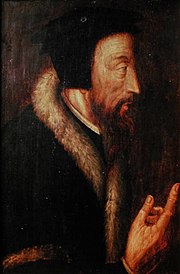
Happy Belated 500th Birthday John Calvin!


This year marks the 500th Anniversary of Calvin's birth which specifically was July 10th:
John Calvin (Middle French: Jean Cauvin; 10 July 1509 – 27 May 1564) was an influential French theologian and pastor during the Protestant Reformation. He was a principal figure in the development of the system of Christian theology later called Calvinism. Originally trained as a humanist lawyer, he broke from the Roman Catholic Church around 1530. After religious tensions provoked a violent uprising against Protestants in France, Calvin fled to Basel, Switzerland, where in 1536 he published the first edition of his seminal work Institutes of the Christian Religion.

In that year, Calvin was invited by William Farel to help reform the church in Geneva. The city council resisted the implementation of Calvin and Farel's ideas, and both men were expelled. At the invitation of Martin Bucer, Calvin proceeded to Strasbourg, where he became the minister of a church of French refugees. He continued to support the reform movement in Geneva, and was eventually invited back to lead its church. Following his return, he introduced new forms of church government and liturgy, despite the opposition of several powerful families in the city who tried to curb his authority. During this period, Michael Servetus, a Spaniard known for his heretical views, arrived in Geneva. He was denounced by Calvin and executed by the city council. Following an influx of supportive refugees and new elections to the city council, Calvin's opponents were forced out. Calvin spent his final years promoting the Reformation both in Geneva and throughout Europe.

Calvin was a tireless polemic and apologetic writer who generated much controversy. He also exchanged cordial and supportive letters with many reformers including Philipp Melanchthon and Heinrich Bullinger. In addition to the Institutes, he wrote commentaries on most books of the Bible as well as theological treatises and confessional documents, and he regularly gave sermons throughout the week in Geneva. Calvin was influenced by the Augustinian tradition, which led him to expound the doctrine of predestination and the absolute sovereignty of God in salvation.

Calvin's writing and preaching provided the seeds for the branch of theology that bears his name. The Presbyterian and other Reformed churches, which look to Calvin as a chief expositor of their beliefs, have spread throughout the world. Calvin's thought exerted considerable influence over major religious figures and entire religious movements, such as Puritanism, and some have argued that his ideas have contributed to the rise of capitalism, individualism, and representative democracy in the West.


So here are some thoughts ranging from the Good side, the Bad side and the Down Right Ugly side of John Calvin's Legacy:

First the Good: Baptists and John Calvin, What Baptists Can Learn From Calvin, Why we should know John Calvin

Next the Bad: Calvinism and Fundamentalism, http://www.founders.org/, Southern Baptist Convention Fundamentalist Takeover, http://www.sbctakeover.com/, A Baptist Perspective: WILL THE RELIGIOUS RIGHT FORM A THIRD POLITICAL PARTY IN 2008?, Theocratic Dominionism Gains Influence

And finally the Down Right Ugly: Suzanne's Bookshelf: Calvin and Servetus, McAtee Critiques Sproul Jr. On Calvin, Theocracy & Severtus, The Servetus Controversy, The Murder of Michael Servetus.

Friday, September 11, 2009

Wikipedia Article Of The Day---Sept. 11, 2009


The Diocletianic Persecution was the last and most severe persecution of Christians in the Roman empire. In 303, Emperor Diocletian and his colleagues Maximian, Galerius, and Constantius issued a series of edicts rescinding Christians' legal rights and demanding they comply with traditional religious practices. Later edicts targeted the clergy and demanded universal sacrifice, ordering all inhabitants to sacrifice to the gods. The persecution varied in intensity across the empire—weakest in Gaul and Britain, where only the first edict was applied, and strongest in the Eastern provinces. Constantius' son, Constantine, on taking the imperial office in 306, restored Christians to full legal equality and returned property confiscated during the persecution. The persecution failed to check the rise of the church. By 324, Constantine was sole ruler of the empire, and Christianity had become his favored religion. Although the persecution resulted in the deaths of—according to one modern estimate—3,000 Christians, and the torture, imprisonment, or dislocation of many more, most Christians avoided punishment. The persecution did, however, cause many churches to split between those who had complied with imperial authority (the traditores), and those who had remained "pure". Modern historians have tended to downplay the scale and depth of the Diocletianic persecution. (Read more... Here.)

Wednesday, November 26, 2008

Dr. Jonas And Balthasar Hübmaier

Dr. Jonas has an interesting post on Balthasar Hubmaier on his Blog---here are a few snippets:
It was my church history professor and mentor in seminary, W. R. Estep that first introduced me to Balthasar Hubmaier. The first time I saw his name in writing I thought, "how do I prounce it?" But, it didn't take too many class sessions in Dr. Estep's course on the Anabaptists before the name became so common that all of us knew how to pronounce it.

The brilliant Hubmaier was born around 1481 in a small town called Friedberg just outside of Augsburg. He attended the University of Freiburg and there came under the tutelage of the great Catholic theologian Dr. John Eck. Hubmaier completed both the bachelor’s and master’s degrees then followed Eck to the University of Ingolstadt where he received the Doctor of Theology degree. Eck once called Hubmaier the most brilliant student he'd ever been associated with. Because of his great preaching ability and keen theological mind he accepted appointment as preacher at the cathedral in Regensburg in 1516. Five years later he became a parish priest in Waldshut and there came into contact with Ulrich Zwingli and the Swiss Reformation. Two years later, he became publicly identified with Zwingli’s reform in Zurich, but soon developed Anabaptist ideas.

...

...An eyewitness to his execution described Hubmaier’s death this way:

To the people he said, “O dear brothers, if I have injured any, in word or deed, may he forgive me for the sake of my merciful God. I forgive all those that have done me harm.”

While his clothes were being removed: “From thee also, O Lord, were the clothes stripped. My clothes will I gladly leave here, only preserve my spirit and my soul, I beseech thee!” Then he added in Latin: “O Lord, into thy hands I commit my spirit,” and spoke no more in Latin.

As they rubbed sulphur and gunpowder into his beard, which he wore rather long, he said, “Oh salt me well, salt me well.” And raising his head, he called out: “O dear brothers, pray God that he will give me patience in this my suffering.”

As his beard and hair caught fire, he cried out, “O Jesus, Jesus.”

Associated Baptist Press has this story today about the original writings of Hubmaier: http://www.abpnews.com/index.php?option=com_content&task=view&id=3667&Itemid=53.

It seems that in just a few months all the writings of Hubmaier are going to be accessible on the internet. Great news about this nearly forgotten Anabaptist reformer! I have told my classes for years that if Hubmaier had lived out his full lifespan his influence in the 16th century might have rivaled that of Luther and Calvin.


Read the whole post at Dr. J's Blog. Besides, Bruce Springsteen, I remember Hubmaier being one of Dr. J's most passionate subjects---well Anabaptist history and church history in general. Here are a few more thoughts on the influential Radical Reformer:
[edit] Reformer and Anabaptist
In 1522 he became acquainted with Heinrich Glarean, (Conrad Grebel's teacher) and Erasmus at Basel. In March, 1523, in Zürich, Hubmaier met with Huldrych Zwingli, and even participated in a disputation there in October of that same year. In the disputation, he set forth the principle of obedience to the Scriptures. It was evidently here that Hubmaier committed to abandoning infant baptism, a practice he could not support with Scripture.

Anabaptist Wilhelm Reublin arrived in Waldshut in 1525, having been driven out of Zürich. In April Reublin baptized Hubmaier and sixty others.

In December 1525, Hubmaier fled to Zürich to escape the Austrian army. Hoping to find refuge, Zwingli instead had him arrested. While a prisoner, Hubmaier requested a disputation on baptism, which was granted. The disputation yielded some unusual events. Ten men, four of whom Hubmaier requested, were present for the disputation. Within the discussion, Hubmaier proceeded to quote statements by Zwingli in which he asserted that children should not be baptized until they had been instructed. Zwingli responded that he had been misunderstood. The bewildered Hubmaier agreed to recant. But before the congregation the next day, he attested the mental and spiritual anguish brought on by his actions and stated "I can and I will not recant." Back in prison and under the torture of the rack, he did offer the required recantation. With this, he was allowed to leave Switzerland and journeyed to Nikolsburg in Moravia. This weakness troubled him deeply and brought forth his Short Apology in 1526, which includes the statements: "I may err—I am a man—but a heretic I cannot be... O God, pardon me my weakness".


Anyways, digitizing his works is a great way of preserving his works for future generations and introducing him to a younger audience.

Friday, October 31, 2008

Martin Luther's 95 Theses

Theses
[11]Out of love for the truth and the desire to bring it to light, the following propositions will be discussed at Wittenberg, under the presidency of the Reverend Father Martin Luther, Master of Arts and of Sacred Theology, and Lecturer in Ordinary on the same at that place. Wherefore he requests that those who are unable to be present and debate orally with us, may do so by letter. In the Name our Lord Jesus Christ. Amen.

1. Our Lord and Master Jesus Christ, when He said Poenitentiam agite, willed that the whole life of believers should be repentance.

2. This word cannot be understood to mean sacramental penance, i.e., confession and satisfaction, which is administered by the priests.

3. Yet it means not inward repentance only; nay, there is no inward repentance which does not outwardly work divers mortifications of the flesh.

4. The penalty [of sin], therefore, continues so long as hatred of self continues; for this is the true inward repentance, and continues until our entrance into the kingdom of heaven.

5. The pope does not intend to remit, and cannot remit any penalties other than those which he has imposed either by his own authority or by that of the Canons.

6. The pope cannot remit any guilt, except by declaring that it has been remitted by God and by assenting to God's remission; though, to be sure, he may grant remission in cases reserved to his judgment. If his right to grant remission in such cases were despised, the guilt would remain entirely unforgiven.

7. God remits guilt to no one whom He does not, at the same time, humble in all things and bring into subjection to His vicar, the priest.

8. The penitential canons are imposed only on the living, and, according to them, nothing should be imposed on the dying.

9. Therefore the Holy Spirit in the pope is kind to us, because in his decrees he always makes exception of the article of death and of necessity.

10. Ignorant and wicked are the doings of those priests who, in the case of the dying, reserve canonical penances for purgatory.

11. This changing of the canonical penalty to the penalty of purgatory is quite evidently one of the tares that were sown while the bishops slept.

12. In former times the canonical penalties were imposed not after, but before absolution, as tests of true contrition.

13. The dying are freed by death from all penalties; they are already dead to canonical rules, and have a right to be released from them.

14. The imperfect health [of soul], that is to say, the imperfect love, of the dying brings with it, of necessity, great fear; and the smaller the love, the greater is the fear.

15. This fear and horror is sufficient of itself alone (to say nothing of other things) to constitute the penalty of purgatory, since it is very near to the horror of despair.

16. Hell, purgatory, and heaven seem to differ as do despair, almost-despair, and the assurance of safety.

17. With souls in purgatory it seems necessary that horror should grow less and love increase.

18. It seems unproved, either by reason or Scripture, that they are outside the state of merit, that is to say, of increasing love.

19. Again, it seems unproved that they, or at least that all of them, are certain or assured of their own blessedness, though we may be quite certain of it.

20. Therefore by "full remission of all penalties" the pope means not actually "of all," but only of those imposed by himself.

21. Therefore those preachers of indulgences are in error, who say that by the pope's indulgences a man is freed from every penalty, and saved;

22. Whereas he remits to souls in purgatory no penalty which, according to the canons, they would have had to pay in this life.

23. If it is at all possible to grant to any one the remission of all penalties whatsoever, it is certain that this remission can be granted only to the most perfect, that is, to the very fewest.

24. It must needs be, therefore, that the greater part of the people are deceived by that indiscriminate and highsounding promise of release from penalty.

25. The power which the pope has, in a general way, over purgatory, is just like the power which any bishop or curate has, in a special way, within his own diocese or parish.

26. The pope does well when he grants remission to souls [in purgatory], not by the power of the keys (which he does not possess), but by way of intercession.

27. They preach man who say that so soon as the penny jingles into the money-box, the soul flies out [of purgatory].

28. It is certain that when the penny jingles into the money-box, gain and avarice can be increased, but the result of the intercession of the Church is in the power of God alone.

29. Who knows whether all the souls in purgatory wish to be bought out of it, as in the legend of Sts. Severinus and Paschal.

30. No one is sure that his own contrition is sincere; much less that he has attained full remission.

31. Rare as is the man that is truly penitent, so rare is also the man who truly buys indulgences, i.e., such men are most rare.

32. They will be condemned eternally, together with their teachers, who believe themselves sure of their salvation because they have letters of pardon.

33. Men must be on their guard against those who say that the pope's pardons are that inestimable gift of God by which man is reconciled to Him;

34. For these "graces of pardon" concern only the penalties of sacramental satisfaction, and these are appointed by man.

35. They preach no Christian doctrine who teach that contrition is not necessary in those who intend to buy souls out of purgatory or to buy confessionalia.

36. Every truly repentant Christian has a right to full remission of penalty and guilt, even without letters of pardon.

37. Every true Christian, whether living or dead, has part in all the blessings of Christ and the Church; and this is granted him by God, even without letters of pardon.

38. Nevertheless, the remission and participation [in the blessings of the Church] which are granted by the pope are in no way to be despised, for they are, as I have said, the declaration of divine remission.

39. It is most difficult, even for the very keenest theologians, at one and the same time to commend to the people the abundance of pardons and [the need of] true contrition.

40. True contrition seeks and loves penalties, but liberal pardons only relax penalties and cause them to be hated, or at least, furnish an occasion [for hating them].

41. Apostolic pardons are to be preached with caution, lest the people may falsely think them preferable to other good works of love.

42. Christians are to be taught that the pope does not intend the buying of pardons to be compared in any way to works of mercy.

43. Christians are to be taught that he who gives to the poor or lends to the needy does a better work than buying pardons;

44. Because love grows by works of love, and man becomes better; but by pardons man does not grow better, only more free from penalty.

45. Christians are to be taught that he who sees a man in need, and passes him by, and gives [his money] for pardons, purchases not the indulgences of the pope, but the indignation of God.

46. Christians are to be taught that unless they have more than they need, they are bound to keep back what is necessary for their own families, and by no means to squander it on pardons.

47. Christians are to be taught that the buying of pardons is a matter of free will, and not of commandment.

48. Christians are to be taught that the pope, in granting pardons, needs, and therefore desires, their devout prayer for him more than the money they bring.

49. Christians are to be taught that the pope's pardons are useful, if they do not put their trust in them; but altogether harmful, if through them they lose their fear of God.

50. Christians are to be taught that if the pope knew the exactions of the pardon-preachers, he would rather that St. Peter's church should go to ashes, than that it should be built up with the skin, flesh and bones of his sheep.

51. Christians are to be taught that it would be the pope's wish, as it is his duty, to give of his own money to very many of those from whom certain hawkers of pardons cajole money, even though the church of St. Peter might have to be sold.

52. The assurance of salvation by letters of pardon is vain, even though the commissary, nay, even though the pope himself, were to stake his soul upon it.

53. They are enemies of Christ and of the pope, who bid the Word of God be altogether silent in some Churches, in order that pardons may be preached in others.

54. Injury is done the Word of God when, in the same sermon, an equal or a longer time is spent on pardons than on this Word.

55. It must be the intention of the pope that if pardons, which are a very small thing, are celebrated with one bell, with single processions and ceremonies, then the Gospel, which is the very greatest thing, should be preached with a hundred bells, a hundred processions, a hundred ceremonies.

56. The "treasures of the Church," out of which the pope. grants indulgences, are not sufficiently named or known among the people of Christ.

57. That they are not temporal treasures is certainly evident, for many of the vendors do not pour out such treasures so easily, but only gather them.

58. Nor are they the merits of Christ and the Saints, for even without the pope, these always work grace for the inner man, and the cross, death, and hell for the outward man.

59. St. Lawrence said that the treasures of the Church were the Church's poor, but he spoke according to the usage of the word in his own time.

60. Without rashness we say that the keys of the Church, given by Christ's merit, are that treasure;

61. For it is clear that for the remission of penalties and of reserved cases, the power of the pope is of itself sufficient.

62. The true treasure of the Church is the Most Holy Gospel of the glory and the grace of God.

63. But this treasure is naturally most odious, for it makes the first to be last.

64. On the other hand, the treasure of indulgences is naturally most acceptable, for it makes the last to be first.

65. Therefore the treasures of the Gospel are nets with which they formerly were wont to fish for men of riches.

66. The treasures of the indulgences are nets with which they now fish for the riches of men.

67. The indulgences which the preachers cry as the "greatest graces" are known to be truly such, in so far as they promote gain.

68. Yet they are in truth the very smallest graces compared with the grace of God and the piety of the Cross.

69. Bishops and curates are bound to admit the commissaries of apostolic pardons, with all reverence.

70. But still more are they bound to strain all their eyes and attend with all their ears, lest these men preach their own dreams instead of the commission of the pope.

71. He who speaks against the truth of apostolic pardons, let him be anathema and accursed!

72. But he who guards against the lust and license of the pardon-preachers, let him be blessed!

73. The pope justly thunders against those who, by any art, contrive the injury of the traffic in pardons.

74. But much more does he intend to thunder against those who use the pretext of pardons to contrive the injury of holy love and truth.

75. To think the papal pardons so great that they could absolve a man even if he had committed an impossible sin and violated the Mother of God -- this is madness.

76. We say, on the contrary, that the papal pardons are not able to remove the very least of venial sins, so far as its guilt is concerned.

77. It is said that even St. Peter, if he were now Pope, could not bestow greater graces; this is blasphemy against St. Peter and against the pope.

78. We say, on the contrary, that even the present pope, and any pope at all, has greater graces at his disposal; to wit, the Gospel, powers, gifts of healing, etc., as it is written in I. Corinthians xii.

79. To say that the cross, emblazoned with the papal arms, which is set up [by the preachers of indulgences], is of equal worth with the Cross of Christ, is blasphemy.

80. The bishops, curates and theologians who allow such talk to be spread among the people, will have an account to render.

81. This unbridled preaching of pardons makes it no easy matter, even for learned men, to rescue the reverence due to the pope from slander, or even from the shrewd questionings of the laity.

82. To wit: -- "Why does not the pope empty purgatory, for the sake of holy love and of the dire need of the souls that are there, if he redeems an infinite number of souls for the sake of miserable money with which to build a Church? The former reasons would be most just; the latter is most trivial."

83. Again: -- "Why are mortuary and anniversary masses for the dead continued, and why does he not return or permit the withdrawal of the endowments founded on their behalf, since it is wrong to pray for the redeemed?"

84. Again: -- "What is this new piety of God and the pope, that for money they allow a man who is impious and their enemy to buy out of purgatory the pious soul of a friend of God, and do not rather, because of that pious and beloved soul's own need, free it for pure love's sake?"

85. Again: -- "Why are the penitential canons long since in actual fact and through disuse abrogated and dead, now satisfied by the granting of indulgences, as though they were still alive and in force?"

86. Again: -- "Why does not the pope, whose wealth is to-day greater than the riches of the richest, build just this one church of St. Peter with his own money, rather than with the money of poor believers?"

87. Again: -- "What is it that the pope remits, and what participation does he grant to those who, by perfect contrition, have a right to full remission and participation?"

88. Again: -- "What greater blessing could come to the Church than if the pope were to do a hundred times a day what he now does once, and bestow on every believer these remissions and participations?"

89. "Since the pope, by his pardons, seeks the salvation of souls rather than money, why does he suspend the indulgences and pardons granted heretofore, since these have equal efficacy?"

90. To repress these arguments and scruples of the laity by force alone, and not to resolve them by giving reasons, is to expose the Church and the pope to the ridicule of their enemies, and to make Christians unhappy.

91. If, therefore, pardons were preached according to the spirit and mind of the pope, all these doubts would be readily resolved; nay, they would not exist.

92. Away, then, with all those prophets who say to the people of Christ, "Peace, peace," and there is no peace!

93. Blessed be all those prophets who say to the people of Christ, "Cross, cross," and there is no cross!

94. Christians are to be exhorted that they be diligent in following Christ, their Head, through penalties, deaths, and hell;

95. And thus be confident of entering into heaven rather through many tribulations, than through the assurance of peace.

Happy Reformation Day!


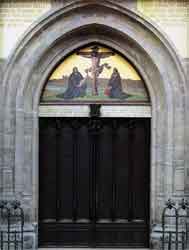
We didn't have as many trick-or-treaters this year, so that was a bit of a letdown, but in other news on Oct. 31, in 1517 the Protestant Reformation gets a kickstart, when Martin Luther posts his 95 theses on the door of the Castle Church in Wittenberg, Germany.

Here is Dr. Jonas' post on the subject:

Friday, October 31, 2008
Thank You Martin Luther!
On this evening, exactly 491 years ago, Martin Luther nailed his "95 Theses" to the door of the Castle Church in Wittenberg. The "95 Theses" concerned the sale of indulgences (forgiveness of sin in return for a certain amount of money) which, given his shift in theology, particularly his doctrine of salvation, Luther thought was reprehensible.

I have sort of resisted saying that this act "started" the Reformation because I usually like to give some credit to "pre-Reformation" reformers like Hus and Wycliffe. Nevertheless, Luther's protest against the sale of indulgences was the spark that was needed that set off the powder-keg in the 16th century called the Reformation.

And so, this evening, I think it is good to remember and celebrate the life and work of this great man, Martin Luther!

posted by Glenn Jonas at 2:30 PM | 0 comments

Monday, October 13, 2008

Learn All The Church Councils: From The Early Ecumenical Councils To Vatican II

Here is a timeline of all 21 Councils in Church History:


MAJOR COUNCILS OF THE CHURCH---Source: Daily Catholic.Org

The First Council of Nicaea

Though the Council of Jerusalem (Acts 15 and Galatians 2) was the first Church Council, attended by the Apostles, the first Ecumenical (world-wide) Council was called by the Roman Emperor Constantine the Great with Pope Saint Sylvester I sitting on the Throne of Peter as the 33rd successor of Christ's appointed Apostle. The site was the city of Nicaea, just south of Constantinople in Asia Minor. The greatest periti was the Bishop of Alexandria, Saint Athanasius who, amidst his struggles with the Arians, argued convincingly for condemning Arius and, as a deacon, St. Athanasius was at the forefront in defining the Consubstantiality of the Son with the Heavenly Father.

The First Council Constantinople

Fifty-six years after Nicaea, the Roman Emperor of the East Theodosius I convened the second General Council. Because of friction between the emperor who was headquartered in Constantinople and Pope Saint Damasus I, located in Rome, neither the Holy Father or his papal legates attended. Already the split between East and West was manifesting itself. 186 bishops did attend. Most notable were Doctors of the Chur Saint Gregory Nazianzen and Saint Cyril of Jerusalem, who with the Council Fathers, reaffirmed the First Council of Nicaea and defined the Consubstantiality of the Holy Spirit with the Father and the Son, thereby condeming the heresy of Macedonius.

Council of Ephesus

Fifty years after the First Council of Constantinople, Theodosius' son Theodosius II ruled as emperor. He was much more inclined to hear the Church, influenced by his saintly sister Saint Pulcheria and, in harmony with Pope Saint Celestine I, a third General Council was called in Ephesus in the southern tip of Asia Minor. Over 200 bishops attended, declaring the Divine Maternity Dogma of the Blessed Virgin Mary as the Mother of God. Also, led by Saint Cyril of Alexandria, the Council defined that Christ has two natures - Divine and human, but only one Person which is Divine. This affirmation condemned Nestorianism and deposed Nestorius, who was the bishop of Constantinople. The Council also affirmed the Council of Carthage held for the local Church in 416, thus condemning Pelagius and his teachings.

The Council of Chalcedon

Twenty years after Ephesus, Saint Pulcheria played a key role in the fourth General Council; this time influencing her husband Marcian, then the Roman Emperor of the East, to coordinate with Pope Saint Leo the Great in convening it at Chalcedon in Thessalonica just northwest of Constantinople. Once again a false teaching was at the heart of the meeting. This time Monophysitism (the false teaching that Christ had only one nature) was at the forefront of controversy. It was taught by the Abbot Eutyches who also sought discord, causing confusion so that the Council asserted that Constantinople should be on an equal basis with Rome ecclesiastically. Vigorously opposing this and Eutyches, Pope Leo determined in his Dogmatic Epistle of October 10, 451 that the See of Peter in Rome is and always shall be the Seat of Primacy with no equal and that Eutyches was a heretic. Leo was proclaimed the 'Soul of Chalcedon' and the Council agreed unanimously that through Leo, Peter had spoken and Eutyches was condemned.

Second Council of Constantinople

Just over a century after Chalcedon, heresy was running rampant and the Roman Emperor in Constantinople Justinian I decided it was time for another General Council. The Second Council in Constantinople condemned the "Three Chapters" which was a collection of statements by three deceased disciples of the deposed Nestorius. The Council determined that the writings of Theodore of Mopsuestia, Theodoret of Cyrrhus, and Ibas of Edessa were soundly condemned. This Council also affirmed the condemnations declared at the Council of Carthage in 416 and previous condemnations by Popes of heresies.


Third Council of Constantinople


117 years after the Second Council of Constantinople, the Emperor Constantine IV decided it was time to call another General Council, especially in light of the growing threat of Islamism. In agreement with Pope Saint Agatho, the Council was convened with again over 200 bishops. The heresy of the time was Monothelitesism which falsely taught that Christ only had a Divine will, rather than a Divine and human will. It denied the perfect harmony of the two wills within the one Divine Person. Pope Agatho died during this Council and his successor Pope Saint Leo II continued it, approving the decrees of past Councils and taking to task one of his predecessors Pope Honorius I for not keeping the heresy of Monothelites in check, specifically not challenging the Patriarch of Constantinople Sergius who was spreading the heresy. St. Leo's actions set a precedence for calling into question error by previous Pontiffs and confirmed that a Pope can be in error when not speaking from the Chair of Peter - ex cathedra.

Second Council of Nicaea

Just over a century after the Third Council of Constantinople, a 7th General Council was necessary in 787 to deal with the heresy of Iconoclasm. The Council was called by the Empress Irene - the widow of the late Emperor Leo IV and mother of the Emperor Constantine IV - to head off the growing unrest with the Eastern Bishops who were spreading the heresy of Iconoclasm fostered by Emperor Leo III. The latter had been fiercely condemned by Pope Hadrian I, as well as his predecessors Popes Gregory II and Pope Gregory III. A great Doctor of the Church Saint John Damascene had also defended images as a means of reverence. At the core was the growing split and resentment between East and West.

Fourth Council of Constantinople

The issue of declaring Photius a heretic was paramount for the Fourth Council of Constantinople which was called jointly by the Emperor Basil and Pope Hadrian II in 869. Photius had openly criticized clerical celibacy, challenged Pope Saint Leo III's crowning of Charlemagne as Holy Roman Emperor on Christmas of 800, and questioned the Filioque of the Creed. Photius was condemned by the Council. 200 years later the Great Eastern Schism became official when Michael Cerularius closed the Latin churches in Constantinople and was excommunicated by Pope Saint Leo IV in 1054. Also of concern at the Council was the growing Saracen threat.

First Lateran Council

The first General Council after the Great Eastern Schism was held in Rome for the first time at the Lateran Basilica in 1123 and convened by Pope Callistus II. At issue was the Lay Investiture controversy between secular power and ecclesial power. The Council confirmed the Concordat of Worms that had been signed the year before between Emperor Henry V and Pope Callistus II. This assured all elections of prelates and abbots would be made by ecclesial authorities solely with the Emperor having approval only in Germany. The Council declared priests in the Latin rite must remain celibate.

Second Lateran Council

It was necessary to call a second General Council just 16 years later because of the Papal schism in which Pope Innocent II declared null and void all acts and decrees by the deceased antipope Anicletus II. The Council also condemned the heresies of Peter Bruys and Arnold of Brescia as well as enacting reforms suggested by Saint Bernard of Clairvaux who also preached a crusade against the threat of the Crescent Moon of Islam.

Third Lateran Council

Pope Alexander III called the third Council at the Lateran Basilica because once again a General Council had to be called to undo the damage done by antipopes Victor IV and others. The Council also set the election of the Roman Pontiff must be by two-thirds of the majority of cardinals voting, establishing the Sacred Conclave as the voting body. The Council condemned the heresies of Albigenses and Waldenses.

Fourth Lateran Council
In 1215 Pope Innocent III called the Fourth Lateran Council 36 years after Lateran III had closed. This Council was the most absolute and most impacting of all ecumenical councils to date. Nearly 500 prelates, as well as the Patriarchs of Constantinople and Jerusalem, and close to a thousand abbots including Saint Dominic attended. Here Innocent, trying to recover from the immense sadness three years earlier of the failed Children's Crusade (5th Crusade) , successfully regained his power. It marked the pinnacle of papal power in medieval times. It was Innocent who defined ex cathedra - from the chair of Peter and who declared in that position that "There is but one Universal Church, outside of which there is no salvation." The Council officially set in stone the term 'Transubstantiation' for the mystery of the bread and wine confected into the body and blood of Jesus Christ and reformed disciplines of ecclesiastical life, as well as directing all Catholics to partake in the Sacraments of Penance and the Holy Eucharist no less than once a year. Lateran IV also condemned as anathema once more the heresies of Albigensianism, which taught marriage and the sacraments were not needed, and Waldensianism, which taught that the laity could perform the same duties as a priest when said priest was in mortal sin.

First Council of Lyons


30-years after Lateran IV, Pope Innocent IV called the First Council of Lyons in 1245, having been forced to flee Rome for the refuge of Lyons France at the invitation of the holy French Monarch King Saint Louis IX. The latter was designated to lead the Seventh Crusade against the infidel Saracens. Though only 140 bishops were at Lyons, it had the support of the Patriarchs of Antioch, Constantinople, Venice and the Emperor of the East. The Council reinforced the excommunication Pope Gregory IX had imposed on Frederick II, the slacker emperor who had betrayed the trust placed in him. He was deposed. Great concern was also given to the Mongol hordes invading Europe and the loss of Jerusalem to the infidel, as well as problems with lax clergy.

Second Council of Lyons


In 1274 Blessed Pope Gregory X called the Second Council of Lyons, which teemed with 15 cardinals, 500 prelates and well over a thousand clerics and dignitaries including Saint Bonaventure. Another great Doctor of the Church, Saint Thomas Aquinas passed to his Heavenly reward enroute to the Council. This Council's main docket was the attempt to reunite with the Eastern Church, but it was only temporary and the schism grew wider after the solidification of the Dogmatic Filioque in which it was reaffirmed emphatically that the Holy Ghost proceeds from both the Father and the Son. Also addressed were regulations for Papal election and how to recover Palestine from the Turks.

Council of Vienne


Six years into the 'Avignon Exile' (1305-1377), the Council of Vienne lasted two years. It was called in 1311 by the first of the Avignon Popes Pope Clement V in the city of Vienne just south of Lyons. Though the Patriarchs of Antioch and Alexandria joined the Pope, it was a noticable difference from the last Council for far fewer bishops and dignitaries attended. Nevertheless, the council suppressed the Knights Templars and Jacques de Molay, the one who laid the satanic seeds of Freemasonry. They had abused their privileges after the Crusades. Politics also played a huge role in this council with King Philip IV ruler of France being reinstituted in the Church after his legendary excommunication battle with Clement's predecessor Pope Boniface VIII who had issued his famous ex cathedra bull Unam Sanctam. The Council also condemned various heresies.

Council of Constance

Just over a century after the Council of Vienne the 16th Ecumenical Council was called in the French area of Switzerland in 1414. Because of the Great Western Schism the legitimate Pope Gregory XII abdicated the Papal throne during the Council at the Emperor Sigismund's request for the sake of unity so that the Council could sort out the mess and end the Schism amid the confusion of the multi-popes which included the anti-popes of Avignon - Benedict XIII and John XXIII. The latter had called a Council in Pisa in 1403 which was not recognized because of its illegality. The Council took control and elected Pope Martin V to the seat of Peter in 1417, three years after the Council was opened. It brought to an end the Great Schism and opened a whole new can of worms with the struggle between papal power and conciliar power. Condemned were the heresies of John Wycliffe and John Hus, the tip of the iceberg that would erupt a century later.

Council of Florence

Though it is called the Council of Florence, it began in Basel, Switzerland, called by Pope Martin V. But Martin V did not live to open it. Instead his successor Blessed Pope Eugene IV opened it and met open resistance from many of the bishops. Therefore he dissolved the Council, moving to Ferrara, Italy in 1438 because of the schismatic bishops who elected the antipope Felix V. In 1439 the bubonic plague forced the entire Council to move again, this time to Florence where it was closed eight years later in 1447 by the Eugene IV. Though the Greek Church agreed to accept Filioque, it was shortlived for the infidels conquered Constantinople six years after the Council closed and, demoralized, the Eastern Church stuck to their stubborn agenda. The most stunning aspect of this Council was that Papal Authority triumphed over conciliar authority. Pope Eugene IV, backed by the Council proclaimed infallible the dogma of no salvation for anyone outside the Church in his noted Papal Bull Cantate Domino.

Fifth Lateran Council

Despite Blessed Pope Eugene IV's Papal Bull Cantate Domino problems abounded less than a century later. Thus Pope Julius II, trying to recoup the scandals caused by previous pontiffs - specifically the Borgia Pope Alexander VI - called the 18th Ecumenical Council, returning to the Lateran for the Fifth Synod in 1512. When Julius died, his successor Pope Leo X carried on the Council. No doctrine was proclaimed with all decrees primarily disciplinary in trying to stem the tide of Martin Luther and others who were outwardly rebelling against the Church. Though the idea of a Crusade against the Turks was brought up, the problems with the growing Protestant Reformation occupied the agenda. The Council reaffirmed the superiority of the Pope over conciliar powers.

Council of Trent

The greatest and longest of all the major ecumenical councils was convened by Pope Paul III on December 13, 1545 in the mouintain village of Trent in northern Italy. There were 25 major sessions that spanned eighteen years under five popes - Pope Julius III, Marcellus II, Paul IV and Pope Pius IV who closed the last session on December 4, 1563 with Pius IV issuing a Papal Bull on February 7, 1564 confirming all that was declared at Trent. Pope Saint Pius V completed the commission of Trent, reforming the Roman Missal with his De Defectibus and Quo Primum writing the Catechism of Trent based on all the decrees of Trent and also set up a commission to issue a more exact edition of the Latin Vulgate Bible. The Council issued the most dogmatic and reformatory decrees ever, specifically on the Holy Eucharist, the Holy Sacrifice of the Mass and the Sacraments plus reinstating traditions always held 'Catholic.' Trent was the ideal Counter-Reformation to the Protestant Reformation where Protestantism was condemned as anathema along with Martin Luther and other reformers who had bolted the Church. Moral discipline was emphasized and reinforced in order that Holy Mother Church regain the respect and authority intended for the Church Christ founded and passed down through His infallible, perennial Magisterium of the Church, preserving the Truths and Traditions of Holy Mother Church in the Sacred Deposit of the Faith.

First Vatican Council


Many consider the First Vatican Council as the longest ever because, in truth, it has never been closed. Convened by Pope Pius IX on December 8, 1869 with 803 of the hierarchy present from the universal Church, it only had four sessions, all reaffirming the course of Trent. In the 4th Session on July 18, 1870 the Council affirmed the dogma of infallibility of the Sovereign Pontiff.

Second Vatican Council


The last of the Ecumenical Councils was, indeed, not only the most controversial but the very portal for allowing the ambiguous language of the documents to open a Pandora's Box that has proven over the past 40 plus years that there are no fruits per Our Lord's words in St. Matthew 7: 15-20. Because of the heresies promoted so subtly, we have the ruin today, not of the Roman Catholic Church per se, but of the man-made church that began in 1962 and broke away from the one true Church founded by Christ in order to join the over 33,000 false sects that have rejected what the Son of God mandated, thinking man knows better than the Divine. This has resulted in so-called church leaders and others to interpret dogma and doctrine in a Protestant light with an emphasis on humanism, ecumenism, religious liberty, and collegiality in an effort to conform to the modern world rather than the world adhering to what the Church had always taught. This is, in effect, The Great Apostasy foretold in sacred scripture and by saints, and Our Lady, most notably at Quito and LaSalette. From this council came the realization of the abomination of desolation Jesus warned of. This council convened by John XXIII on October 11, 1962 and, despite the latter's pleas to "Stop the Council!", it was carried on by his successor Paul VI for three more years, closing on December 8, 1965... (Note: I do not agree with the source's views.)

Friday, September 19, 2008

September 20, 1378


1378 – Papal Schism: Unhappy with Pope Urban VI (pictured), a group of cardinals started a rival papacy with the election of Antipope Clement VII, throwing the Roman Catholic Church into turmoil. Read more here: http://en.wikipedia.org/wiki/Papal_schism.