Showing posts with label history. Show all posts

Monday, June 1, 2009

Last Survivor of Titanic Dies in England


Gerry Penny, AFP / Getty Images


Death Comes on 98th Anniversary of Launch of Famous Ship
By JILL LAWLESS, AP
posted: 56 MINUTES AGOcomments: 324filed under: World NewsPrintShareText SizeAAA

LONDON (May 31) -- Millvina Dean, who as a baby was wrapped in a sack and lowered into a lifeboat in the frigid North Atlantic, died Sunday, having been the last survivor of 1912 sinking of the RMS Titanic.
She was 97 years old, and she died where she had lived — in Southampton, England, the city her family had tried to leave behind when it took the ship's ill-fated maiden voyage, bound for America. She died in her sleep early Sunday, her friend Gunter Babler told the Associated Press. It was the 98th anniversary of the launch of the ship that was billed as "practically unsinkable." Babler said Dean's longtime companion, Bruno Nordmanis, called him in Switzerland to say staff at Woodlands Ridge Nursing Home in Southampton discovered Dean in her room Sunday morning. He said she had been hospitalized with pneumonia last week but she had recovered and returned to the home.

A staff nurse at the nursing home said late Sunday that no one would comment until administrators came on duty Monday morning. Dean just over 2 months old when the Titanic hit an iceberg on the night of April 14, 1912. The ship sank in less than three hours. Dean was one of 706 people — mostly women and children — who survived. Her father was among the 1,517 who died. Babler, who is head of the Switzerland Titanic Society, said Dean was a "very good friend of very many years." "I met her through the Titanic society but she became a friend and I went to see very every month or so," he said.

The pride of the White Star line, the Titanic had a mahogany-paneled smoking room, a swimming pool and a squash court. But it did not have enough lifeboats for all of its 2,200 passengers and crew. Dean's family were steerage passengers setting out from the English port of Southampton for a new life in the United States. Her father had sold his pub and hoped to open a tobacconists' shop in Kansas City, Missouri, where his wife had relatives. Initially scheduled to travel on another ship, the family was transferred to the Titanic because of a coal strike. Four days out of port and about 600 kilometers (380 miles) southeast of Newfoundland, the ship hit an iceberg. The impact buckled the Titanic's hull and sent sea water pouring into six of its supposedly watertight compartments.

Dean said her father's quick actions saved his family. He felt the ship scrape the iceberg and hustled the family out of its third-class quarters and toward the lifeboat that would take them to safety. "That's partly what saved us — because he was so quick. Some people thought the ship was unsinkable," Dean told the British Broadcasting Corp. in 1998. Wrapped in a sack against the Atlantic chill, Dean was lowered into a lifeboat. Her 2-year-old brother Bertram and her mother Georgette also survived. "She said goodbye to my father and he said he'd be along later," Dean said in 2002. "I was put into lifeboat 13. It was a bitterly cold night and eventually we were picked up by the Carpathia." The family was taken to New York, then returned to England with other survivors aboard the rescue ship Adriatic. Dean did not know she had been aboard the Titanic until she was 8 years old, when her mother, about to remarry, told her about her father's death. Her mother, always reticent about the tragedy, died in 1975 at age 95.

Born in London on Feb. 2, 1912, Elizabeth Gladys "Millvina" Dean spent most of her life in the English seaside town of Southampton, Titanic's home port. She never married, and worked as a secretary, retiring in 1972 from an engineering firm.She moved into a nursing home after breaking her hip about three years ago. She had to sell several Titanic mementoes to raise funds, prompting her friends to set up a fund to subsidize her nursing home fees. Leonardo DiCaprio and Kate Winslet, the stars of the film "Titanic," pledged their support to the fund last month. For most of her life Dean had no contact with Titanic enthusiasts and rarely spoke about the disaster. Dean said she had seen the 1958 film "A Night to Remember" with other survivors, but found it so upsetting that she declined to watch any other attempts to put the disaster on celluloid, including the 1997 blockbuster "Titanic."

She began to take part in Titanic-related activities in the 1980s, after the discovery of the ship's wreck in 1985 sparked renewed interest in the disaster. At a memorial service in England, Dean met a group of American Titanic enthusiasts who invited her to a meeting in the U.S. She visited Belfast to see where the ship was built, attended Titanic conventions around the world — where she was mobbed by autograph seekers — and participated in radio and television documentaries about the sinking. Charles Haas, president of the New-Jersey based Titanic International Society, said Dean was happy to talk to children about the Titanic. "She had a soft spot for children," he said. "I remember watching was little tiny children came over clutching pieces of paper for her to sign. She was very good with them, very warm."

In 1997, Dean crossed the Atlantic by boat for the first time, on the QEII luxury liner, and finally visited Kansas City, declaring it "so lovely I could stay here five years." She was active well into her 90s, but missed the commemoration of the 95th anniversary of the disaster in 2007 after breaking her hip. Dean had no memories of the sinking and said she preferred it that way. "I wouldn't want to remember, really," she told The Associated Press in 1997. She opposed attempts to raise the wreck 4,000 meters (13,000 feet) from the sea bed.

"I don't want them to raise it, I think the other survivors would say exactly the same," she said in 1997. "That would be horrible." The last survivor with memories of the sinking — and the last American survivor — was Lillian Asplund, who was 5 at the time. She died in May 2006 at the age of 99. The second-last survivor, Barbara Joyce West Dainton of Truro, England, died in October 2007 aged 96.

Copyright 2009 The Associated Press. The information contained in the AP news report may not be published, broadcast, rewritten or otherwise distributed without the prior written authority of The Associated Press. Active hyperlinks have been inserted by AOL.
2009-05-31 16:42:25


And so we bid farewell to another patron of history... at least, we have Ms. Dean's stories as well as other Titanic survivors' stories recorded for future generations. I can agree with Ms. Dean and the other survivors that it would be horrible to raise the Titanic, but I do hope Titanic researchers bring up as many artifacts as they can as those artifacts are beneficial to the study of history. My hope is that they eventually find The Great Omar, 'the Holy Grail of the Titanic,' but with it being lost at least it provides source material for literary legends and Hollywood. The Great Omar, of course, is a:
special book bound by the famous craft bookbinding firm of Sangorski & Sutcliffe as the centre-piece.

This exquisitely bound edition of The Rubaiyat of Omar Khayyam was lost when it went down with the Titanic in 1912, she said. It took two years of continuous work to create the Great Omar, boasting over 1,000 precious and semi-precious stones and 1,500 separate pieces of leather. The binding is recognised as one of the finest examples of the bookbinder's craft. The only visual record of the book is an old black and white photograph and recently discovered glass negative. With the help of the original patterns and contemporary descriptions the binding has been recreated digitally to actual size by Richard Green and Trickles & Webb.

I decided to buy the poster and have it framed and hung in my living room above my bookshelves. Today, everytime I look at the Great Omar, as the book is affectionately known, I cannot help feeling nostalgic at the loss of such a stunning thing. The Great Omar now lies in an oak casket at the bottom of the Atlantic. Another copy was destroyed during the Blitz during WW2 and the third edition is locked up somewhere in the British Library.
I smell a new Indiana Jones adventure! See also: The Great Omar Poster, The Great Omar, This Old Book: The Great Omar and Fate of Titanic Treasures in Judge's Hands.


Friday, October 31, 2008

Memento Mori: A Halloween Related Post

Post-mortem photography (also known as memorial portraiture or memento mori) is the practice of photographing the recently deceased.

From the above link:
The invention of the daguerreotype in 1839 made portraiture much more commonplace, as many of those who were unable to afford the commission of a painted portrait could afford to sit for a photography session. This cheaper and quicker method also provided the middle class with a means for memorializing dead loved ones.

These photographs served less as a reminder of mortality than as a keepsake to remember the deceased. This was especially common with infants and young children; Victorian era childhood mortality rates were extremely high, and a post-mortem photograph might be the only image of the child the family ever had. The later invention of the carte de visite, which allowed multiple prints to be made from a single negative, meant that copies of the image could be mailed to relatives.

The practice eventually peaked in popularity around the end of the 19th century and died out as "snapshot" photography became more commonplace, although a few examples of formal memorial portraits were still being produced well into the 20th century.


Examples:

Syrian bishop seated in state at his funeral (ca. 1945).

---see: Victorian post-mortem photography.

---Guess who is dead in this photo?

See more examples: Here. While post-mortem photography seems morbid and spooky to us, at the turn of the century, it was one of the only affordable methods of photography for poor families at the time. Post-mortem photography seemed to have waned around World War 2, but has been revitalized by The Now I Lay Me Down to Sleep Foundation to provide comfort, hope and closure for parents who lose their babies in child birth or through other birth defects.

See also: http://www.amazon.com/s/ref=nb_ss_gw?url=search-alias%3Daps&field-keywords=Post-mortem+photography&x=13&y=25.

Jack The Ripper: A Halloween Related Post

Find out about Jack The Ripper, who terrorized Whitechapel and gave London nightmares over 100 years ago:

Jack the Ripper is an alias given to an unidentified serial killer[1] active in the largely impoverished Whitechapel area and adjacent districts of London, England, in the autumn of 1888. The name originated in a letter sent to the London Central News Agency by someone claiming to be the murderer.

The victims were women allegedly earning income as prostitutes, who were killed in public or semi-public places at night or in the early morning. Each victim's throat was cut, after which her body was mutilated. Theories suggest that the victims first were strangled, in order to silence them, which may explain the reported lack of blood at the crime scenes. The removal of internal organs from three of the victims led some officials at the time of the murders to propose that the killer possessed anatomical or surgical knowledge.[2]

Newspapers, whose circulation had been growing during this era,[3] bestowed widespread and enduring notoriety on the killer because of the attacks' savagery and the police's failure to capture the murderer (they sometimes missed him at the crime scenes by mere minutes).[4][5]

Because the killer's identity has never been confirmed, the legends surrounding the murders have become a combination of genuine historical research, folklore, and pseudohistory. Many authors, historians, and amateur detectives have proposed theories about the identity of the killer and his victims.


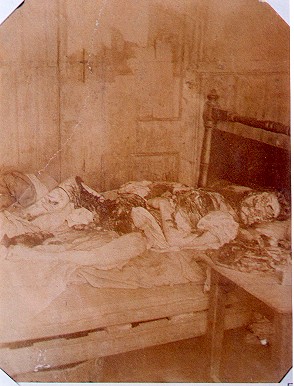
Gruesome crime scene photo:


See also: Casebook: Jack the Ripper for an extensive collection of contemporary newspaper reports related to the murders as well as articles by modern authors.

Somehow silly Halloween songs such as Screaming Lord Sutch's aptly named Jack The Ripper:

1963 version:


1977 version:
---do not seem to evoke the sheer sense of terror and panic London felt all those years ago.

For another Jack that terrorized London's city streets see:

Spring Heeled Jack (also Springheel Jack, Spring-heel Jack, etc), is a character from English folklore said to have existed during the Victorian era and able to jump extraordinarily high. The first claimed sighting of Spring Heeled Jack that is known occurred in 1837.[1] Later alleged sightings were reported all over England, from London up to Sheffield and Liverpool, but they were especially prevalent in suburban London and later in the Midlands and Scotland.[2]

Many theories have been proposed to ascertain the nature and identity of Spring Heeled Jack. The urban legend of Spring Heeled Jack gained immense popularity in its time due to the tales of his bizarre appearance and ability to make extraordinary leaps, to the point where he became the topic of several works of fiction.

Spring Heeled Jack was described by people claiming to have seen him as having a terrifying and frightful appearance, with diabolical physiognomy that included clawed hands and eyes that "resembled red balls of fire". One report claimed that, beneath a black cloak, he wore a helmet and a tight-fitting white garment like an "oilskin". Many stories also mention a "Devil-like" aspect. Spring Heeled Jack was said to be tall and thin, with the appearance of a gentleman, and capable of making great leaps. Several reports mention that he could breathe blue and white flames and that he wore sharp metallic claws at his fingertips. At least two people claimed that he was able to speak in comprehensible English.


Tuesday, October 28, 2008

Could Solomon's Mine Have Been Found?

Mine Dates Back to King Solomon's Time
AP posted: 9 HOURS 28 MINUTES AGO
comments: 247 filed under: Science News, World News
WASHINGTON (Oct. 28) - The fictional King Solomon's Mines held a treasure of gold and diamonds, but archaeologists say the real mines may have supplied the ancient king with copper. Researchers led by Thomas Levy of the University of California, San Diego, and Mohammad Najjar of Jordan's Friends of Archaeology, discovered a copper-production center in southern Jordan that dates to the 10th century B.C., the time of Solomon's reign.

The discovery occurred at Khirbat en-Nahas, which means "ruins of copper" in Arabic. Located south of the Dead Sea, the region was known in the Old Testament as Edom.
Research at the site in the 1970s and 1980s indicated that metalworking began there in the 7th century B.C., long after Solomon.
But Levy and Najjar dug deeper and were able to date materials such as seeds and sticks to the 10th century B.C.
"We can't believe everything ancient writings tell us," Levy said in a statement. "But this research represents a confluence between the archaeological and scientific data and the Bible."
Their findings are reported in Tuesday's issue of Proceedings of the National Academy of Sciences.
Copyright 2008 The Associated Press. The information contained in the AP news report may not be published, broadcast, rewritten or otherwise distributed without the prior written authority of The Associated Press. Active hyperlinks have been inserted by AOL.
2008-10-27 20:28:29

Wednesday, October 8, 2008

Oldest 'Footprints' on Earth Found

Related to the post: Storm Uncovers Fossil in Scientist's Yard---here's a second article related to the first by way of the subject of fossils and paleontology:

Oldest 'Footprints' on Earth Found LiveScience
posted: 2 DAYS 5 HOURS AGOcomments: 958filed under: Science NewsPrintShareText SizeAAA

(Oct. 5) - The oldest-known tracks of a creature apparently using legs have been discovered in rock dated to 570 million years ago in what was once a shallow sea in Nevada.
Scientists think land beasts evolved from ancient creatures that left the sea and evolved lungs and legs. If the new finding is real — the discoverer says will fuel skepticism — it pushes the advent of walking back 30 million years earlier than any previous solid finding.
The aquatic creature left its "footprints" as two parallel rows of small dots, each about 2 millimeters in diameter. Scientists said today that the animal must have stepped lightly onto the soft marine sediment, because its legs only pressed shallow pinpoints into that long-ago sea bed.

The tracks were made during what is called the Ediacaran period, which preceded the Cambrian period, the time when most major groups of animals first evolved. Scientists had once thought only microbes and simple multicellular animals that existed prior to the Cambrian, but that notion is changing, said Ohio State University Professor Loren Babcock.

"We keep talking about the possibility of more complex animals in the Ediacaran — soft corals, some arthropods, and flatworms — but the evidence has not been totally convincing," Babcock said. "But if you find evidence, like we did, of an animal with legs — an animal walking around — then that makes the possibility much more likely."
Soo-Yeun Ahn, a doctoral student at Ohio State, presented the discovery today at a meeting of the Geological Society of America.
Babcock was surveying rocks in the mountains near Goldfield, Nevada, with Hollingsworth in 2000 when he found the tracks.

"This was truly an accidental discovery," he said. "We came on an outcrop that looked like it crossed the Precambrian-Cambrian boundary, so we stopped to take a look at it. We just sat down and started flipping rocks over. We were there less than an hour when I saw it."
Little can be gleaned about what sort of creature it was, but Babcock "reasonably certain — not 100 percent" that it was an arthropod, such as one resembling a centipede or millipede, or by a leg-bearing worm. It might have been about one as wide as a pencil and may have had multiple, spindly legs.
In 2002, other researchers reported a similar fossil trail from Canada that dated back to the middle of the Cambrian period, about 520 million years ago. Another set of tracks found in South China date back to 540 million years ago. At approximately 570 million years old, this new fossil not only provides the earliest suggestion of animals walking on legs, but it also shows that complex animals were alive on earth before the Cambrian.
"I expect that there will be a lot of skepticism," Babcock said about the discovery. "There should be. But I think it will cause some excitement. And it will probably cause some people to look harder at the rocks they already have. Sometimes it's just a matter of thinking differently about the same specimen."
© Imaginova Corp. All rights reserved.
2008-10-05 15:19:49

Storm Uncovers Fossil in Scientist's Yard

Storm Uncovers Fossil in Scientist's Yard AP
posted: 4 DAYS 20 HOURS AGOcomments: 207filed under: Hurricane News, Science NewsPrintShareText SizeAAACAPLEN, Texas (Oct. 3) - A paleontologist whose beachfront home in Texas was destroyed during Hurricane Ike has found a football-size tooth in the debris.
Dorothy Sisk and Jim Westgate are scientists at Lamar University. They discovered the fossil tooth in the front yard of Sisk's home in Caplen on the devastated Bolivar Peninsula. Westgate believes the fossil is from a Columbian mammoth common in North America until around 10,000 years ago.
The tooth looks like a series of boot soles or slices of bread wedged together. It is expected to be sent to the Texas Memorial Museum in Austin.
“This is the first one I’ve found in 19 years,” Westgate is quoted on the Lamar University Web site. “People bring in pieces and parts from the beach for me to identify, and I haven’t seen one in this good a condition."
The official location of the fossil will be recorded as Sisk's address, Westgate told the university.
"Normally we don’t have house addresses for our fossil localities,” he said.
More than 1 million people fled the Texas coast because of Hurricane Ike.
Copyright 2008 The Associated Press. The information contained in the AP news report may not be published, broadcast, rewritten or otherwise distributed without the prior written authority of The Associated Press. Active hyperlinks have been inserted by AOL.
2008-10-02 21:16:31


---obviously Ike was pretty bad, but this is interesting.

Wednesday, October 1, 2008

Evolution Of The Word Virgin

Evolution Of The Word Virgin

From Michael Kirtland:
I have heard that the word virgin suffered a change of context/meaning in the 1300's; that, prior to this time it had been a synonym of "virtuous" or "good" and had no direct tie to sexual purity. This would be consistent with the early renaissance advent of the Virgin Mary's immaculate conception. If true, it would be fascinating to investigate whether or not this etymological evolution is in fact the cornerstone to an entire religion - Catholicism.
---------
The term Virgin Mary first appears in writing in about 1300. Virgin alone originally meant "a pious, unmarried or chaste woman" since about 1200, and by 1300 it meant also "a woman in a state of inviolate chastity". It appears that the Virgin Mary was so dubbed after the change in the word's meaning.

We would not say that the notion of a virgin birth is the cornerstone of Catholicism by any means, but it certainly does play a large role in the Church.

Saturday, September 20, 2008

Renowned Archaeologist Dies at Dig

Georgi Kitov, archaeologist, March 1, 1943 - Sept. 14, 2008

Renowned Archaeologist Dies at DigBy VESELIN TOSHKOV, AP
posted: 1 DAY 3 HOURS AGOcomments: 20filed under: Science NewsPrintShareText SizeAAASOFIA, Bulgaria (Sept. 19) - Archaeologist Georgi Kitov -- an expert on the treasure-rich Thracian culture of antiquity -- died of a heart attack while excavating a temple in central Bulgaria considered to be one of his greatest discoveries, his family said Thursday. He was 65.
Kitov died Sunday during the excavation of a large Thracian temple surrounded by lavishly furnished graves near the village of Starosel, according to his wife, Diana Dimitrova.

The temple, unearthed by Kitov in 2000, as well as other sensational finds over the past 16 years brought him international attention.
His discoveries include two 5th century B.C. gold funerary masks — one weighing a pound — from the Shipka valley in central Bulgaria, a bronze head from a statue of a Thracian ruler, gold and silver jewelry and a complete set of bronze armor.
But he was also criticized for using bulldozers in some of his digs.
Bulgarian archaeologist Nikolai Ovcharov described Kitov as "a phenomenon" in archaeology.
"Many disagreed with his methods, but his great discoveries will be remembered by Bulgarians," Ovcharov said.

Kitov compared the previously little-known Thracian civilization to that of ancient Greece. Though unlike the Greeks, the Thracians had no written language, and so left no records.
"We found indisputable evidence that the Thracian civilization was at least equal to the ancient Greek one," Kitov said in 2004. "In fact, we proved that Thracians were co-authors of the ancient culture, which often is called Hellenistic by mistake."
First mentioned in Homer's Iliad as allies of Troy, the Thracians were an Indo-European nomadic people that settled in the central Balkans around 5,000 years ago. They were conquered by Rome in the 1st century, and were assimilated by invading Slav peoples in the 6th century.
Fierce warriors and horse-breeders, the Thracians were also skilled goldsmiths. They established a powerful kingdom in the 5th century B.C. Its capital was thought to be Seutopolis, whose ancient ruins lie under a large artificial lake near Shipka, in an area dubbed "the Bulgarian Valley of Kings" for its many rich tombs.
Kitov once told The Associated Press that the temple at Starosel "vies with ancient Greek temples in Sparta, Athens and Mycenae."
Some other archaeologists criticized Kitov, however, for using heavy machinery in his digs. Kitov defended his high-speed technique by saying it was necessary to keep ahead of looters.
Some archaeologists also accused him of failing to adequately document or publish his finds.
In 2001, Bulgarian authorities rescinded his excavation permit for a year for allegedly digging without permission.
Sofia's National History Museum Director Bozhidar Dimitrov said Kitov regarded archaeology as a duty more than a job.
"He suffered from the widespread looting, and tried to counteract by digging more and more," Dimitrov said. "Very often he won the race against the looters."
Kitov was born on March 1, 1943, in the southwestern town of Dupnitsa. He earned a history degree from the University of Sofia, and studied art history at the St. Petersburg State University.
He is survived by his wife and 9-year-old daughter. A funeral is planned for Friday.
Copyright 2008 The Associated Press. The information contained in the AP news report may not be published, broadcast, rewritten or otherwise distributed without the prior written authority of The Associated Press. Active hyperlinks have been inserted by AOL.
2008-09-18 15:06:39