Showing posts with label theocratic calvinism. Show all posts

Saturday, March 13, 2010

Texas Schools Vote To Remove Thomas Jefferson


Recently the Texas Board of Education voted on a 10-5 margin to remove Thomas Jefferson from their school curriculum or at least demote him:
Widely regarded as one of the most important of all the founding fathers of the United States, Thomas Jefferson received a demotion of sorts Friday thanks to the Texas Board of Education.

The board voted to enact new teaching standards for history and social studies that will alter which material gets included in school textbooks. It decided to drop Jefferson from a world history section devoted to great political thinkers.


Critics of the Board's decision aka Texas Freedom Network note that the Board is replacing Jefferson with religious figures:
According to Texas Freedom Network, a group that opposes many of the changes put in place by the Board of Education, the original curriculum asked students to "explain the impact of Enlightenment ideas from John Locke, Thomas Hobbes, Voltaire, Charles de Montesquieu, Jean Jacques Rousseau and Thomas Jefferson on political revolutions from 1750 to the present."

That emphasis did not sit well with board member Cynthia Dunbar, who, during Friday's meeting, explained the rationale for changing it. "The Enlightenment was not the only philosophy on which these revolutions were based," Dunbar said.

The new standard, passed at the meeting in a 10-5 vote, now reads, "Explain the impact of the writings of John Locke, Thomas Hobbes, Voltaire, Charles de Montesquieu, Jean Jacques Rousseau, Thomas Aquinas, John Calvin and Sir William Blackstone."

By dropping mention of revolution, and substituting figures such as Aquinas and Calvin for Jefferson, Texas Freedom Network argues, the board had chosen to embrace religious teachings over those of Jefferson, the man who coined the phrase "separation between church and state."


One wonders if the Fundamentalist anti-Separation of Church and State activist and known Texas Board of Education member David Barton had anything to do with this decision. Barton is known for trying to reinvent American history as being solely the product of "Christian" values. On his site Barton promises to present: "America's forgotten history and heroes with an emphasis on our moral, religious and constitutional heritage." Barton's known historical revisionism has gone as far as calling the Separation of Church and State in America "a myth" much like other Fundamentalists do. He is on record as saying that Thomas Jefferson meant the "wall of separation" concept to be "one directional:"
On January 1, 1802, Jefferson wrote to that group of Danbury Baptists, and in this letter, he assured them—he said the First Amendment has erected a wall of separation between church and state, he said, but that wall is a one-directional wall. It keeps the government from running the church, but it makes sure that Christian principles will always stay in government


Anyone who values Religious Liberty and Separation of Church and State not only as Baptist distinctives but as true American values should be appalled by Barton and the Texas Board of Education's antics---not just for Texas' sake but for the sake of the whole of America as Barton's influence extends beyond Texas:
The battle in Texas may be tougher. The State Board of Education is stacked with a vocal cohort of far-right, fundamentalist activists. Fresh from a bruising battle over what to teach about evolution in science class, the board now has social studies and history right in its crosshairs.

The outcome of the battle may reverberate around the country.

“Texas is the second largest purchaser of school textbooks in the country,” Miller told Church & State. “So to avoid spending money on multiple editions, publishers often write their textbooks to meet Texas curriculum standards and then sell those textbooks in other states.”

Barton is also busy trying to slip his perspective into public schools in other ways. He is active in the National Council on Bible Curriculum in Public Schools, a North Carolina group that works to persuade public schools to adopt a fundamentalist-oriented Bible curriculum under the guise of teaching “about” religion. Barton serves on the organization’s advisory board, alongside several other Religious Right figures.

But Barton hasn’t stopped with phony history. He’s increasingly branching out, working to draft churches into right-wing political machines and brazenly asserting that government must be infused with “biblical” principles. Along the way, Barton has made common cause with some extreme elements of the Religious Right.

Barton’s ongoing crusade to recruit clergy into partisan politics is often under the radar. In 2004, the Republican National Committee sent him to evangelical churches around the country in what was described as a “get-out-the-vote” effort.


David Knowles and USA Today also note:

(During the Jefferson voting scandal) the (Texas Board of Education) also voted to strike the word "democratic" from references to the U.S. form of government, replacing it with the term "constitutional republic." Texas textbooks will contain references to "laws of nature and nature's God" in passages that discuss major political ideas.

The board decided to use the words "free enterprise" when describing the U.S. economic system rather than words such as "capitalism," "capitalist" and "free market," which it deemed to have a negative connotation.

Serving 4.7 million students, Texas accounts for a large percentage of the textbook market, and the new standards may influence what is taught in the rest of the country.


Other critics of the Board's decision have written open letters to them and I suggest you do the same if you value America's Religious Freedom.

Friday, March 12, 2010

Hitler And The Nazis' Use Of Romans 13 Against The Confessing Church


Romans 13:1-7 (ESV)

[1] Let every person be subject to the Hitler. For there is no authority except from God, and those that exist have been instituted by God. [2] Therefore whoever resists Hitler resists what God has appointed, and those who resist will incur judgment. [3] For Hitler is not a terror to good conduct, but to bad. Would you have no fear of Hitler? Then do what is good, and you will receive his approval, [4] for he is God’s servant for your good. But if you do wrong, be afraid, for he does not bear the sword in vain. For he is the servant of God, an avenger who carries out God’s wrath on the wrongdoer. [5] Therefore one must be in subjection, not only to avoid God’s wrath but also for the sake of conscience. [6] For the same reason you also pay taxes, for the authorities are ministers of God, attending to this very thing. [7] Pay to all what is owed to them: taxes to whom taxes are owed, revenue to whom revenue is owed, respect to whom respect is owed, honor to whom honor is owed.
Thanks to Pastor I. Todyaso for pointing this version of Romans 13 out.

Hitler and the Nazis indeed abused the text of Romans 13 in the same way that the Afrikaner Calvinists in South Africa did. Hitler commanded blind submission and unquestioning Absolute obedience to him and Nazi policies. In this way likewise the Church and State became unseparated as such:
Hitler, the democratically elected ruler of Germany from 1933 to 1945, commanded both Catholic and Protestant Christian leaders to preach ‘unconditional subjugation’ to Hitler under the pretence of the Holy Bible - specifically, the Book of Romans, Chapter 13. When Hitler’s aim was to disarm Germany's citizenry, Christian leadership obediently mollified their congregations with Romans 13. When Hitler’s aim was to abduct dissidents in the dark quite of the night without due process - Romans 13. When the burning flesh of her lawful neighbors manufactured the air unbreathable - Romans 13. Etc.


National Socialism in Germany developed much in the same way as Afrikaner Calvinism did as Nazism was mainly a stream of Social Calvinism mixed with racism, nationalism, theocracy and separatism though there were other things mixed in that formed Nazism as well such as a syncretic mixture of Christian religion, the Occult and Paganism. Nazi Christianity was truly a corrupt and perverted version of True Christianity as it was a civil religion rather than a Christ-centered relationship focused on the righteousness of God in Christ and the obedience to Christ's command for justice for all.

It should be noted here that the Fundamentalist pastor John MacArthur teaches the literalist interpretation of Romans 13:

“Now listen to this. It doesn’t matter whether your ruler is Caesar, Herod, Pilate, Felix, Fetus, Agrippa, Stalin, Hitler, Winston Churchill, Bill Clinton, it doesn’t matter who it is, he says be subject, you teach them to be subject.” — John MacArthur.


And this was exactly the attitude in Germany at first---people were unwilling to criticize/debate the Nazi regime publicly possibly out of fear for their lives; fear for the safety of their families; fear for their future; fear on numerous levels but mainly because the Nazis weren't after them. The Nazis protected the interests of the Status Quo. Gradually within this stifling political climate a reactionary movement within the Church began to spring up known as the Confessing Church led by Karl Barth, Dietrich Bonnhoeffer and many others who followed the Reformed tradition of resisting the State began to speak out against Nazism and Hitler. They also wrote and distibuted anti-Nazi propaganda such as the Barmen Declaration and after the war, the Stuttgart Declaration Of Guilt and also, the Darmstadt Statement.

Martin Niemoller a former Hitler supporter who became another leading figure of the Confessing Church summarized his change of heart in this famous poem:
“They came first for the Communists,

and I didn't speak up because I wasn't a Communist.

Then they came for the Jews,

and I didn't speak up because I wasn't a Jew.

Then they came for the trade unionists,

and I didn't speak up because I wasn't a trade unionist.

Then they came for the Catholics,

and I didn't speak up because I was a Protestant.

Then they came for me,

and by that time no one was left to speak up.”


- Reverend Martin Niemoller, Lutheran Pastor arrested by the Gestapo in 1937


Hitler tried to quell the Confessing Church's dissent by misusing the Romans 13 passage of course:
The Nazi government led by Hitler used Romans 13:1 against the resistance movements in the German church. Nazi leaders argued that since Hitler was duly elected, opposing him was opposing God's instituted authority. Faithful opposition countered by saying blind allegiance to Hitler was idolatrous and that what he proposed and lived out clearly opposed Scripture: "We must obey God rather than any human authority" (Acts 5:29)...

Romans 13:1 in its proper context says government is to uphold good (godly) behavior and punish bad (13:3). We're to honor this authority, but there are limits beyond which we will not go. This cost many in Germany their lives! - link


However to no avail because for Barth and the Confessing Church not only was Jesus the one and only True Lord for Christians/God the only True King but the Church was neither under nor over the State---but set apart for a Higher Calling which included being a critic of the Status Quo of the State. The Barmen Declaration highlights their points with these statements:
8.10 - 1. "I am the way, and the truth, and the life; no one comes to the Father, but by me." (John 14.6). "Truly, truly, I say to you, he who does not enter the sheepfold by the door, but climbs in by another way, that man is a thief and a robber. . . . I am the door; if anyone enters by me, he will be saved." (John 10:1, 9.)
8.11 Jesus Christ, as he is attested for us in Holy Scripture, is the one Word of God which we have to hear and which we have to trust and obey in life and in death.
8.12 We reiect the false doctrine, as though the church could and would have to acknowledge as a source of its proclamation, apart from and besides this one Word of God, still other events and powers, figures and truths, as God's revelation.

8.13 - 2. "Christ Jesus, whom God has made our wisdom, our righteousness and sanctification and redemption." (1 Cor. 1:30.)
8.14 As Jesus Christ is God's assurance of the forgiveness of all our sins, so, in the same way and with the same seriousness he is also God's mighty claim upon our whole life. Through him befalls us a joyful deliverance from the godless fetters of this world for a free, grateful service to his creatures.
8.15 We reiect the false doctrine, as though there were areas of our life in which we would not belong to Jesus Christ, but to other lords--areas in which we would not need justification and sanctification through him.

8.16 - 3. "Rather, speaking the truth in love, we are to grow up in every way into him who is the head, into Christ, from whom the whole body [is] joined and knit together." (Eph. 4:15,16.)
8.17 The Christian Church is the congregation of the brethren in which Jesus Christ acts presently as the Lord in Word and sacrament through the Holy Spirit. As the Church of pardoned sinners, it has to testify in the midst of a sinful world, with its faith as with its obedience, with its message as with its order, that it is solely his property, and that it lives and wants to live solely from his comfort and from his direction in the expectation of his appearance.
8.18 We reject the false doctrine, as though the Church were permitted to abandon the form of its message and order to its own pleasure or to changes in prevailing ideological and political convictions.

8.19 - 4. "You know that the rulers of the Gentiles lord it over them, and their great men excercise authority over them. It shall not be so among you; but whoever would be great among you must be your srvant." (Matt. 20:25,26.)
8.20 The various offices in the Church do not establish a dominion of some over the others; on the contrary, they are for the excercise of the ministry entrusted to and enjoined upon the whole congregation.
8.21 We reject the false doctrine, as though the Church, apart from this ministry, could and were permitted to give itself, or allow to be given to it, special leaders vested with ruling powers.

8.22 - 5. "Fear God. Honor the emperor." (1 Peter 2:17.)
Scripture tells us that, in the as yet unredeemed world in which the Church also exists, the State has by divine appointment the task of providing for justice and peace. [It fulfills this task] by means of the threat and exercise of force, according to the measure of human judgment and human ability. The Church acknowledges the benefit of this divine appointment in gratitude and reverence before him. It calls to mind the Kingdom of God, God's commandment and righteousness, and thereby the responsibility both of rulers and of the ruled. It trusts and obeys the power of the Word by which God upholds all things.
8.23 We reject the false doctrine, as though the State, over and beyond its special commision, should and could become the single and totalitarian order of human life, thus fulfilling the Church's vocation as well.
8.24 We reject the false doctrine, as though the Church, over and beyond its special commission, should and could appropriate the characteristics, the tasks, and the dignity of the State, thus itself becoming an organ of the State.

8.25 - 6. "Lo, I am with you always, to the close of the age." (Matt. 28:20.) "The word of God is not fettered." (2 Tim. 2:9.)
8.26 The Church's commission, upon which its freedom is founded, consists in delivering the message of th free grace of God to all people in Christ's stead, and therefore in the ministry of his own Word and work through sermon and sacrament.
8.27 We reject the false doctrine, as though the Church in human arrogance could place the Word and work of the Lord in the service of any arbitrarily chosen desires, purposes, and plans.
8.28 The Confessional Synod of the German Evangelical Church declares that it sees in the acknowledgment of these truths and in the rejection of these errors the indispensable theological basis of the German Evangelical Church as a federation of Confessional Churches. It invites all who are able to accept its declaration to be mindful of these theological principles in their decisions in Church politics. It entreats all whom it concerns to return to the unity of faith, love, and hope.


I'll leave you with one more video on the Confessing Church:


Next I'll post on Romans 13 and the Religious Right...

Thursday, March 11, 2010

Romans 13, Afrikaner Calvinism And The Kairos Document

If you haven't read all about my blogging woes read this first: TheoPoetic Musings: Stupid Blogger Messed Up My Post::John Calvin's View Of Romans 13 In Libertarian, Neo-Orthodox And Baptist Thought Part 1.

It's irritating because my mild cerebral palsy makes it hard enough just to type everything out though I manage---let alone the time it takes to look everything up. Typing with tremors makes my arms get tired easily so I get worn out just by the very act of typing---but here I blog I cannot do otherwise. Anyways recouping my loss I decided to go in a different direction and re-post the main ideas of my former two posts as several sections of short and brief posts as to make sure all the information gets posted this time---even if the exact wording and flow has changed this go round.

Moving on to my Post Proper:
Afrikaner Calvinism is, according to theory, a unique cultural development that combined the Calvinist religion with the political aspirations of the white Afrikaans speaking people of South Africa.
Though there were theological aspects of Afrikaner Calvinism, it was mainly a stream of Social Calvinism mixed with racism, nationalism, theocracy and separatism. The political climate in which these ideas arose was the product of an unseparated Church and State. These views led these so-called Christians to accept the unChristian position of Apartheid much like Southern Baptists in the US supported slavery.

So that's one grouping of Christians in South Africa during the time of Apartheid who had a very Theocratic understanding of Romans 13 as they literally believed that God ordained their racism---God had ordained Apartheid. On the one hand you had the Afrikaner Calvinists who used Calvinism to their own glory and as a means to their own ends contrary to Calvin's views. Let it be noted now that Calvinism as one movement in the whole of Christian tradition in it's truest sense is about glorifying God and following Christ not humanity as is the whole of Christianity. So if Christ God's Word in the Scriptures is attested to being God's Love for us---how can God ordain nationalistic racism? Is hatred and theo-political divisionism truly of God? Can a State built on separatism and racism let alone any government be Christian in any sense of the word?

On the other hand you had a very different grouping of Christians---a group of predominantly black South African theologians of different traditions within the whole of Christian tradition who came together to answer these questions. Utilizing the Reformed tradition of resisting the State and a different understanding of Romans 13---their answer is summarized in The Kairos Document:
The Kairos Document (KD) is a theological statement issued in 1985 by a group of black South African theologians based predominantly in the black townships of Soweto, South Africa. The statement challenged the churches' response to what the authors saw as the vicious policies of the Apartheid state under the State of Emergency declared on 21 July 1985. The KD evoked strong reactions and furious debates not only in South Africa, but world-wide.

The KD is a prime example of contextual theology and liberation theology in South Africa, and has served as an example for attempted, similarly critical writing at decisive moments in several other countries and contexts (Latin America, Europe, Zimbabwe, India, etc.).


One of the main points of The Kairos Document relates directly to Romans 13 as summarized here:
Chapter Two: Critique of State Theology
'State theology' is defined as, "the theological justification of the status quo with its racism, capitalism and totalitarianism... It does [this] by misusing theological concepts and biblical texts for its own political purposes" (p. 3). The government, as well as parts of the church, are accused of using state theology. Four examples are discussed.

[edit] Romans 13:1-7
"'State Theology' assumes that in this text Paul is presenting us with the absolute and definitive Christian doctrine about the State ... and absolute and universal principle ... The falseness of this assumption has been pointed out by many biblical scholars" (p. 4). Reference is made to Käsemann's Commentary on Romans, as well as Cullmann's The State in the New Testament.

The KD authors insist that texts must be understood in their context: within a particular writing (here: Romans); within the Bible as a whole; and within the particular historical context (here: Paul and the community in Rome). Note that, "In the rest of the Bible, God does not demand obedience to oppressive rulers ... Rom 13:1-7 cannot contradict all of this" (p. 4).

The letter known as the Biblical book Romans was sent to an early Christian community in Rome that could be characterized as 'antinomian' or 'enthusiast.' Roman Christians thought that "because Jesus ... was their Lord and King," every authority should be obeyed. Paul was arguing against such an understanding; that is, he is "not addressing the issue of a just or unjust State." Attention is drawn to Rom 13:4 ("the State is there for your benefit"): "That is the kind of State that must be obeyed." The question of an unjust government is not addressed in Rom 13 but, for example, in Revelation 13 (p. 5).


The full statement is worded as such:
2.1 Romans 13:1-7

The misuse of this famous text is not confined to the present government in South Africa. Throughout the history of Christianity totalitarian regimes have tried to legitimize an attitude of blind obedience and absolute servility towards the state by quoting this text. The well-known theologian Oscar Cullman, pointed this out thirty years ago:

As soon as Christians, out of loyalty to the gospel of Jesus, offer resistance to a State's totalitarian claim, the representatives of the State or their collaborationist theological advisers are accustomed to appeal to this saying of Paul, as if Christians are here commended to endorse and thus to abet all the crimes of a totalitarian State. ( The State in the New Testament, SCM 1957 p 56.)

But what then is the meaning of Rom 13:1-7 and why is the use made of it by 'State Theology' unjustifiable from a biblical point of view?

'State Theology' assumes that in this text Paul is presenting us with the absolute and definitive Christian doctrine about the State, in other words an absolute and universal principle that is equally valid for all times and in all circumstances. The falseness of this assumption has been pointed out by numerous biblical scholars (see, for example, E Kasemann, Commentary on Romans, SCM, p 354-7; 0 Cullmann, The State in the New Testament, SCM, p 55-7).

What has been overlooked here is one of the most fundamental of all principles of biblical interpretation: every text must be interpreted in its context. To abstract a text from its context and to interpret it in the abstract is to distort the meaning of God's Word. Moreover the context here is not only the chapters and verses that precede and succeed this particular text nor is it even limited to the total context of the Bible. The context includes also the circumstances in which Paul's statement was made. Paul was writing to a particular Christian community in Rome, a community that had its own particular problems in relation to the State at that time and in those circumstances. That is part of the context of our text.

Many authors have drawn attention to the fact that in the rest of the Bible God does not demand obedience to oppressive rulers. Examples can be given ranging from Pharaoh to Pilate and through into Apostolic times. The Jews and later the Christians did not believe that their imperial overlords, the Egyptians, the Babylonians, the Greeks or the Romans, had some kind of divine right to rule them and oppress them. These empires were the beasts described in the Book of Daniel and the Book of Revelations. God allowed them to rule for a while but he did not approve of what they did. It was not God's will. His will was the freedom and liberation of Israel. Rom 13:1-7 cannot be contradicting all of this.

But most revealing of all is the circumstances of the Roman Christians to whom Paul was writing. They were not revolutionaries. They were not trying to overthrow the State. They were not calling for a change of government. They were, what has been called, 'antinomians' or 'enthusiasts' and their belief was that Christians, and only Christians, were exonerated from obeying any State at all, any government or political authority at all, because Jesus alone was their Lord and King. This is of course heretical and Paul is compelled to point out to these Christians that before the second coming of Christ there will always be some kind of State, some kind of secular government and that Christians are not exonerated from subjection to some kind of political authority.

Paul is simply not addressing the issue of a just or unjust State or the need to change one government for another. He is simply establishing the fact that there will be some kind of secular authority and that Christians as such are not exonerated from subjection to secular laws and authorities. He does not say anything at all about what they should do when the State becomes unjust and oppressive. That is another question.

Consequently those who try to find answers to the very different questions and problems of our time in the text of Rom 13:1-7 are doing a great disservice to Paul. The use that 'State Theology' makes of this text tells us more about the political options of 'those who construct this theology than it does about the meaning of God's Word in this text. As one biblical scholar puts it: "The primary concern is to justify the interests of the State and the text is pressed into its service without respect for the context and the intention of Paul."

If we wish to search the Bible for guidance in a situation where the State that is supposed to be "the servant of God" (Romans 13:16) betrays that calling and begins to serve Satan instead, then we can study chapter 13 of the Book of Revelations. Here the Roman State becomes the servant of the dragon (the devil) and takes on the appearance of a horrible beast. Its days are numbered because God will not permit his unfaithful servant to reign forever.


Next I'll post on Romans 13, Hitler, the Nazis and the Confessing Church...

Monday, December 21, 2009

North Carolina's Constitution Anti-Separation Of Church And State

Weird stuff all around:
No faith, no service?

I was surprised to learn that the North Carolina Constitution has a provision that disallows persons who don't believe in God from public service. The issue came to light after Cecil Bothwell, who describes himself as a "post-theist," was elected to the Asheville City Council, creating a stir among some conservatives and making national headlines.

Bothwell is a long-time environmentalist, resident, and author. He has been a syndicated coumnist, wrote a best-selling guidebook to Asheville, and in 2007 published a biography of evangelist Billy Graham, who lives in nearby Black Mountain. Bothwell belongs to the Unitarian Universalist Church, which is home to many folks who are skeptical about God's existence but still value spirituality, fellowship, and social justice. That's not enough to satisfy critics, including Mark Creech, who leads the North Carolina-based Christian Action League. I appreciate Mark, especially with regard to his opposition to alcohol and the lottery, but I have to disagree with him on this one.

It's true -- and a bit mind-boggling -- that the N.C. Constitution seems to think belief in God is an essential characteristic for all office holders. You can look it up:
Article Six, Section 8 says
The following persons shall be disqualified for office:
First, any person who shall deny the being of Almighty God.
Second, with respect to any office that is filled by election by the people, any person who is not qualified to vote in an election for that office.
Third, any person who has been adjudged guilty of treason or any other felony against this State or the United States, or any person who has been adjudged guilty of a felony in another state that also would be a felony if it had been committed in this State, or any person who has been adjudged guilty of corruption or malpractice in any office, or any person who has been removed by impeachment from any office, and who has not been restored to the rights of citizenship in the manner prescribed by law.

It's interesting to note that atheists are disqualified even before would-be candidates who aren't qualified to vote or who have committed treason or other felonies.


Dr. Cartledge goes on to state:
Relying heavily on David Barton's The Myth of Separation, which argues against church-state separation, Creech holds that "the founders" intended only that there should be no denominational test (Anglican, Presbyterian, etc.), assuming that all potential office holders would be Christian. In addition, he suggests (with the late D. James Kennedy) that those who don't believe in God have no external basis for life-affirming values and thus have no business serving the public.
Read the full article here: Baptists Today Blogs: No faith, no service? Mark Creech's arguments are typical theocratic nonsense.

Monday, October 12, 2009

Gott Mit Uns/God With Us: Hitler And Fundamentalists

The church and state unseparated:


Church & State

Hitler in front of "Church of our Lady" in Nuremberg, Sept. 1934. Photographer, Heinrich Hoffmann.


Christian Cross with Nazi Flag

From a Heinrich Hoffmann photo book titled: HITLER BAUT GROßDEUTSCHLAND (Hitler Constructs Greater Germany) which follows Hitler in Austria in the spring of 1938.


One of the reasons that I use the Nazis frequently in my parodies of the Fundamentalists of the Religious Right variety is because the Nazis serve as a warning from our recent past about mixing church and state together in a blended marriage. However, this is not to say Fundamentalists are evil people though Fundamentalism is a social evil---there are good Fundamentalists who stand for church and state separation and all. Besides as Romans says:
Romans 3:22-26 RSV: [22] the righteousness of God through faith in Jesus Christ for all who believe. For there is no distinction;
[23] since all have sinned and fall short of the glory of God,
[24] they are justified by his grace as a gift, through the redemption which is in Christ Jesus,
[25] whom God put forward as an expiation by his blood, to be received by faith. This was to show God's righteousness, because in his divine forbearance he had passed over former sins;
[26] it was to prove at the present time that he himself is righteous and that he justifies him who has faith in Jesus.
This is just a warning against the Christian Right's idea of mixing their view of the church with the American government. Anyways, here are some comparisons of Nazi and Fundamentalist ideas:

Protestant fundamentalists of Nazi Germany backed Hitler's laws which included such things as:
The first law, The Law for the Protection of German Blood and German Honour, prohibited marriages and extramarital intercourse between "Jews" (the name was now officially used in place of "non-Aryans") and "Germans" and also the employment of "German" females under forty-five in Jewish household

Household-

The household is "the basic residential unit in which production , consumption , inheritance, child rearing, and shelter are organized and carried out"; [the household] "may or may not be synonomous with family"....
s. The second law, The Reich Citizenship Law , stripped persons not considered of German blood of their German citizenship

Citizenship-

Citizenship refers to a person's membership in a political community such as a country or city. It has different legal definitions in different countries....
and introduced a new distinction between "Reich citizens" and "nationals".
Theological liberals like Dietrich Bonhoeffer completely opposed this. The Religious Right support Proposition 8 which denies the rights of non-heterosexual citizens. Theological liberals completely oppose Proposition 8. Also Pat Robertson has said:
US Constitution: For Christians Only

The Constitution of the United States, for instance, is a marvelous document for self-government by the Christian people. But the minute you turn the document into the hands of non-Christian people and atheistic people they can use it to destroy the very foundation of our society. And that's what's been happening.
-- Pat Robertson, The 700 Club television program, December 30, 1981

Only Christians and Jews in Government

Individual Christians are the only ones really -- and Jewish people, those who trust God of Abraham, Isaac, and Jacob -- are the only ones that are qualified to have the reign, because hopefully, they will be governed by God and submit to Him.
-- Pat Robertson, The 700 Club television program, January 11, 1985, defending his stance that only Christians and Jews are fit to hold public office


Hitler wrote:
"I believe that I am acting in accordance with the will of the Almighty Creator: by defending myself against the Jew, I am fighting for the work of the Lord.."
Fundamentalists frequently state that they have God on their side and that they are doing the will of the Lord by supporting militarism and violence and defending their ideas by such means. Even more so by Extremist Fundamentalists who actually do commit violent acts in the name of God like bombing abortion clinics. Here's a quote from a Fundamentalist:
"I want you to just let a wave of intolerance wash over you. I want you to let a wave of hatred wash over you. Yes, hate is good...Our goal is a Christian nation. We have a Biblical duty, we are called by God, to conquer this country. We don't want equal time. We don't want pluralism."--Randall Terry, Founder of Operation Rescue, The News-Sentinel, Fort Wayne, Indiana, 8-16-93


Hitler believed that Jesus wasn't a God of Love but a 'Divine Warrior.' He said:
"My feelings as a Christian points me to my Lord and Savior as a fighter. It points me to the man who once in loneliness, surrounded by a few followers, recognized these Jews for what they were and summoned men to fight against them and who, God's truth! was greatest not as a sufferer but as a fighter. In boundless love as a Christian and as a man I read through the passage which tells us how the Lord at last rose in His might and seized the scourge to drive out of the Temple the brood of vipers and adders. How terrific was His fight for the world against the Jewish poison. To-day, after two thousand years, with deepest emotion I recognize more profoundly than ever before the fact that it was for this that He had to shed His blood upon the Cross. As a Christian I have no duty to allow myself to be cheated, but I have the duty to be a fighter for truth and justice... And if there is anything which could demonstrate that we are acting rightly it is the distress that daily grows. For as a Christian I have also a duty to my own people.

-Adolf Hitler, in a speech on 12 April 1922 (Norman H. Baynes, ed. The Speeches of Adolf Hitler, April 1922-August 1939, Vol. 1 of 2, pp. 19-20, Oxford University Press, 1942)
Certain Fundamentalists also believe that Jesus is a 'Divine Warrior.' Here's a quote from a Fundamentalist---John Eldredge:
Churches too often expect men to "check their manhood at the door." They picture Jesus as effeminate, as "Mister Rogers with a beard," according to John Eldredge.

There are two problems with this view of Jesus: (1) it's not accurate, and (2) no man wants to follow a feminized man. Men are looking for a real man to follow: dynamic, outspoken, bold, sharp-edged. They want a leader who is decisive, tough, and fair. They respect a man who tells it like it is and doesn't mince words, even when it makes them mad. Men most respect a leader who doesn't care what others think of him.

Ironic, isn't it? The Jesus of Scripture was exactly this kind of man.... Truth is, the Jesus of Scripture is more General Patton than Mister Rogers.

Jesus Christ is the most courageous, masculine man ever to walk the earth. But we've turned Him into a wimp. His manliness and toughness are seldom spoken of, and men fall away because of it. Present the Christ of Scripture, and men will be irresistibly drawn to Him.


Other Hitler quotes of note:
It matters not whether these weapons of ours are humane: if they gain us our freedom, they are justified before our conscience and before our God.

-Adolf Hitler, in Munich, 01 Aug. 1923

The Government, being resolved to undertake the political and moral purification of our public life, are creating and securing the conditions necessary for a really profound revival of religious life.... The National Government regard the two Christian Confessions as the weightiest factors for the maintenance of our nationality. They will respect the agreements concluded between them and the federal States. Their rights are not to be infringed.... It will be the Government's care to maintain honest co-operation between Church and State; the struggle against materialistic views and for a real national community is just as much in the interest of the German nation as in that of the welfare of our Christian faith. The Government of the Reich, who regard Christianity as the unshakable foundation of the morals and moral code of the nation, attach the greatest value to friendly relations with the Holy See and are endeavouring to develop them.

-Adolf Hitler, in his speech to the Reichstag on 23 March 1933

God the Almighty has made our nation. By defending its existence we are defending His work....

Only He can relieve me of this duty Who called me to it. It was in the hand of Providence to snuff me out by the bomb that exploded only one and a half meters from me on July 20, and thus to terminate my life's work. That the Almighty protected me on that day I consider a renewed affirmation of the task entrusted to me....

Therefore, it is all the more necessary on this twelfth anniversary of the rise to power to strengthen the heart more than ever before and to steel ourselves in the holy determination to wield the sword, no-matter where and under what circumstances, until final victory crowns our efforts....

In the years to come I shall continue on this road, uncompromisingly safeguarding my people's interests, oblivious to all misery and danger, and filled with the holy conviction that God the Almighty will not abandon him who, during all his life, had no desire but to save his people from a fate it had never deserved, neither by virtue of its number nor by way of its importance....

In vowing ourselves to one another, we are entitled to stand before the Almighty and ask Him for His grace and His blessing. No people can do more than that everybody who can fight, fights, and that everybody who can work, works, and that they all sacrifice in common, filled with but one thought: to safeguard freedom and national honor and thus the future of life.

-Adolf Hitler, in a radio address, 30 Jan. 1945
Other Fundamentalist quotes of note:
"Don't you feel it rather interesting that every time you have a story about terrorism, it is linked to Muslim extremists? You don't hear somebody, 'Christian extremist killing film producers, Christian extremists blowing up trains.' It just doesn't happen. But it's Muslim extremists and, ladies and gentlemen, Islam, at least at its core, teaches violence. It's there in the Quran in clear, bold statements. Well over 100 verses dealing with violence against infidels, and that is what they're taught. They're also taught to sacrifice themselves in jihad against infidels to gain paradise. It is part of the teaching of that faith. And I know people so reluctant to say, 'Lets not identify those terrorists with these wonderful people.' Well, yes, they may be wonderful people, but this is what that faith teaches, and those who believe it sincerely in their hearts are those that think Osama bin Laden is their great hero. And I think we need to recognize that. Political correctness says that you're not supposed to recognize this, but it just happens to be the truth. Every story, you see it over and over again, Muslim extremists blew up trains, Muslim extremists assassinated film producers. Muslim extremists blew up a crowded shopping center in Netanya [Israel]. Muslim extremists, it's always Muslims, and that's where it comes from, it's the breeding ground. And then it's radical clerics who incite this kind of violence, and it's time we recognize it and begin to deal with it."
--The 700 Club, July 14, 2005 [Looks like Pat forgot about Timothy McVeigh, most of the Old Testament (chock full of violence) and those Christian extremists who protest military funerals]

"You know it's an amazing thing -- this is a Christian country, it's founded by Christians, Christmas is one of our great celebrations. It's been a time of joy for our people for many years, and not only us, but now they're picking up Christmas in Japan, picking it up in China. It's something that has blessed the world. And if people don't like America and the traditions that made America great, let them go to Saudi Arabia, let them go to Pakistan. Yeah, they can go to the Sudan and find a wonderful Muslim holiday."
--The 700 Club, December 23, 2004

ROBERTSON: They gamed it, these guys are out and out communists, they are radicals, you know some of them killers, and they are propagandists of the first order and they don't want anybody else except them. That's why Regent University for example is so terrifically important and why we're setting up an undergraduate program that hopefully will see shortly 10,000 students, and then from there 250,000 because you don't want your child to be brainwashed by these radicals, you just don't want it to happen. Not only brainwashed but beat up, they beat these people up, cower them into submission. Ahhh! "The Professors", read it.
--Transcript of Pat Robertson and Terri Meeuwsen conversation on the March 21, 2006 edition of The 700 Club

"This country does not belong to the ACLU, the radical left or the communists. It belongs to God and his people. I frankly am tired of us being second-class citizens in a land our forefathers founded and claimed for the Lord."
"We have had a distortion imposed on us over the past few years by left-wingers who have fastened themselves into the court system and we have had a lie foisted on us that there is something embedded in the Constitution called separation of church and state."
"When I suggested that God had lifted his protection from this land that we had enjoyed for many years, the people were incensed."
"We cannot stand before God and say we're righteous when we have the blood of 40 million unborn babies on our hands."
--Pat Robertson, speaking at the 2002 "Road To Victory" convention

"The strategy against the American radical left should be the same as General Douglas MacArthur employed against the Japanese in the Pacific... bypass their strongholds, then surround them, isolate them bombard them, then blast the individuals out of their power bunkers with hand-to-hand combat. The battle for Iwo Jima was not pleasant, but our troops won it. The battle to regain the soul of America won't be pleasant either, but we will win it."
--"Pat Robertson's Perspective," April-May 1992

"We should invade their countries, kill their leaders and convert them to Christianity. We weren't punctilious about locating and punishing only Hitler and his top officers. We carpet-bombed German cities; we killed civilians. That's war. And this is war."

"Not all Muslims may be terrorists, but all terrorists are Muslims."---Ann Coulter.

"Yes, religion and politics do mix. America is a nation based on biblical principles. Christian values dominate our government. The test of those values is the Bible. Politicians who do not use the bible to guide their public and private lives do not belong in office."---Beverly LaHaye.

"There should be absolutely no 'Separation of Church and State' in America."---David Barton

"The long-term goal of Christians in politics should be to gain exclusive control over the franchise. Those who refuse to submit publicly to the eternal sanctions of God by submitting to His Church's public marks of the covenant–baptism and holy communion–must be denied citizenship."

"This is God's world, not Satan's. Christians are the lawful heirs, not non-Christians."---Gary North.

"We're fighting against humanism, we're fighting against liberalism...we are fighting against all the systems of Satan that are destroying our nation today...our battle is with Satan himself."

"AIDS is the wrath of a just God against homosexuals. To oppose it would be like an Israelite jumping in the Red Sea to save one of Pharoah's chariotters."---Jerry Falwell.

Sunday, September 13, 2009

That Baptist Ain't Right: Fundamentalist Designs in Washington, DC

That Baptist Ain't Right: Fundamentalist Designs in Washington, DC---The Talibangelicals leading the way towards greed, power and theocratic Calvinism since 1979---in this post That Baptist Ain't Right links to this article: 'Family': Fundamentalism, Friends In High Places. Here's an excerpt:
In the book The Family: The Secret Fundamentalism at the Heart of American Power, author Jeff Sharlet examines the power wielded by a secretive Christian group known as the Family, or the Fellowship.

Founded in 1935 in opposition to FDR's New Deal, the evangelical group's views on religion and politics are so singular that some other Christian-right organizations consider them heretical

The group also has a connection to a house in Washington, D.C., known as C Street. Owned by a foundation affiliated with the Family, C Street is officially registered as a church; in practice, it serves as a meeting place and residence for politicians like South Carolina Gov. Mark Sanford, Nevada Sen. John Ensign and Oklahoma Sen. Tom Coburn.

The Family, Sharlet writes, is responsible for founding the annual National Prayer Breakfast, a supposedly ecumenical — but implicitly Christian — event attended by the president, members of Congress and dignitaries from around the world. These foreign delegations are often led by top defense personnel, who use it as an opportunity to lobby the most influential people in Washington — and who repay the Family with access to their governments.

Sunday, June 14, 2009

Iran Erupts In Violent Protests

It seems Safari is doing better today though I still think all my Blog widgets also may be partly responsible for loading problems as well as Summer time web traffic. So let me know if you're having trouble too?


Anyways, over the weekend Iran erupted in violent protests almost akin to 30 years ago---except this time the cry is for a regime change that supports more progressive leaning political aims rather than the all familiar theocracy that was established 30 years ago. Americans who were alive then remember watching with much trepidation the unfolding drama of the Iran Hostage Crisis which was our first taste of the newly established Iranian theocracy---so of course this sole event colors any American political commentary on Iran. What can I say, we are biased by it---because most average Americans don't realize all the complex details that have shaped the Iranian political climate.

The Iranian Revolution is one of the single events in human history which shows us that theocracy is a bad idea. Though the Iranian theocracy is one built on militant Islam---we Christians don't have bloodless hands as we had our own Irans such as the Christian Iran of the 16th century---Calvin's Geneva. See also: TheoPoetic Musings: Fundamentalists Never Cease To Be Laughable and TheoPoetic Musings: Respect For John Calvin. Thankfully the majority of Christians moved beyond theocracy especially Baptists. Anti-theocracy tendencies have always been a part of the Baptist heritage. Consider these statements:
"Enforced uniformity confounds civil and religious liberty and denies the principles of Christianity and civility. No man shall be required to worship or maintain a worship against his will.”
“God requireth not a uniformity of religion to be enacted in any civil state; which enforced uniformity (sooner or later) is the greatest occasion of civil war, ravishing of conscience, persecution of Christ Jesus in his servants, and of the hypocrisy and destruction of millions of souls.”
“All civil states, with their officers of justice, in their respective constitutions and administrations, are proved essentially civil, and therefore not judges, governors, or defenders of the spiritual, or Christian, state and worship.”---Roger Williams

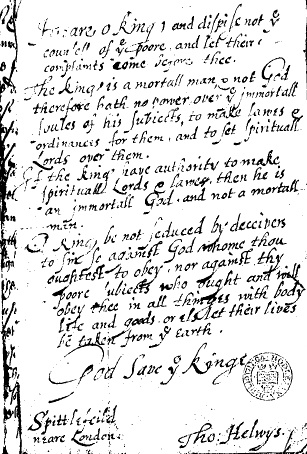
Wee do freely profess that our Lord the King hath no more power over their [Roman Catholics’] coonsciences than over ours, and that is none at all ... let [people] be heretikes, Turks, Jews, or whatsoever, it apperteynes not to the earthly power to punish them in the least measure.
Thomas Helwys

1640
"When they [the Church] have opened a gap in the hedge or wall of separation between the garden of the church and the wilderness of the world, God hath ever broke down the wall itself, removed the Candlestick, etc., and made His Garden a wilderness as it is this day. And that therefore if He will ever please to restore His garden and Paradise again, it must of necessity be walled in peculiarly unto Himself from the world, and all that be saved out of the world are to be transplanted out of the wilderness of the World." Roger Williams, "Mr. Cotton's Letter Lately Printed, Examined and Answered," The Complete Writings of Roger Williams, Vol. 1, 108.

1773
"Religious matters are to be separated from the jurisdiction of the state, not because they are beneath the interests of the state but, quite to the contrary, because they are too high and holy and thus are beyond the competence of the state." Isaac Backus, colonial Baptist from New England, An Appeal to the Public for Religious Liberty.

1790
"The notion of a Christian commonwealth should be exploded forever. ... Government should protect every man in thinking and speaking freely, and see that one does not abuse another. The liberty I contend for is more than toleration. The very idea of toleration is despicable; it supposes that some have a pre-eminence above the rest to grant indulgence, whereas all should be equally free, Jews, Turks, Pagans and Christians." John Leland, "A Chronicle of His Time in Virginia," The Writings of the Later Elder John Leland, published in 1845.---Assorted quotes on Baptists and liberty


It should be noted that a large majority of Muslims have followed suit and are believers of separation of religion and government like the Republic Of Turkey. And like our Muslim friends, we too have nutcases in favor of theocracy: Pat Robertson, Worldview Weekend, the Religious Right, etc. to name a few.

We can only hope that an Ataturk will rise up in Iran to free his/her people someday for the sake of all the Iranians who are longing for a government that truly promotes freedom and democracy. More on Iran later until then see also: Shuck and Jive: Yeah, right..

Monday, May 18, 2009

Fundamentalists Never Cease To Be Laughable

Here is a post from Bruce Prescott: on the subject: Mainstream Baptist: Mohler Contemptuous of Islam:
Thursday, May 14, 2009
Mohler Contemptuous of Islam

While the Pope makes a visit to the Middle East trying to defuse conflict between Christians and Muslims, Southern Seminary President Al Mohler fans the flames of conflict with a religiously arrogant and contemptous blog that denounces extending any respect to Islam.

After the arrogant and contemptuous way Mohler and other fundamentalist takeover leaders treated the Mainstream and moderate Baptists in their own denomination, I have exceedingly low expectations for civility from any of them. But, lives are at stake in the Middle East and around the world when people like Mohler persist in fomenting a clash of civilizations.

Mohler would not consider it respectful to him as a person if an Imam had said:
"We can respect Christian people for their contributions to human welfare, scholarship, and culture. We can respect the brilliance of Christian scholarship in the Roman era and the wonders of Christian art and architecture. But we cannot respect a belief system that denies that Mohammad was a prophet, insists that he was a demon-possessed pedophile, and encourages soldiers to evangelize millions in occupied lands." (Note: This is a hypothetical quotation, not an actual quotation)


Why would he think that any Muslim feels respected when he says:
We can respect Muslim people for their contributions to human welfare, scholarship, and culture. We can respect the brilliance of Muslim scholarship in the medieval era and the wonders of Islamic art and architecture. But we cannot respect a belief system that denies the truth of the gospel, insists that Jesus was not God's Son, and takes millions of souls captive. (Note: This is an actual quotation)


Frankly, in my experience, I find Muslims more respectful of Christianity than I find Evangelical Christians respectful of Islam. When will Evangelicals learn that it is possible to respectfully disagree?

Posted by Dr. Bruce Prescott at 10:20 AM


I have to agree with Tauratinzwe's comment:
Tauratinzwe said...
What do you expect of Mohler? He's contemptuous of committed christians also if they don't bow down to him.
I must add too that Mohler must also be jealous of Islam's hold on the Middle East via fear and theocracies in certain countries---after all that is Mohler and his cronies' goal to Christianize America by fear and establishing a Calvinazi theocracy here in America. No thanks, I'll pass on a theocratic police state---for we saw how well it worked out in Geneva especially for the Anabaptists and in the Puritan colonies. I'd rather keep America a secular nation where we have the freedom to choose our religious expressions or non-religious expressions without fear of being put to death. I'm not sure if it would get that bad if Mohler and the Religious Right did succeed in establishing a fundamentalist theocracy but some of their statements scarily allude to it especially in their defense of Calvin's atrocities such as:
Calvin’s Persecution

I think the scariest thing Todd says is this about Calvin’s role in the execution of Michael Servetus:
Now, putting the execution aside, which of us has it right, and which of us has it wrong here? Whose attitude — forget the execution — whose attitude is more biblical and more correct? … one is tolerant, the other one is intolerant of heresy. Period. It’s that black and white. So were they wrong or are we wrong?


This is like saying, “Except for the part that is wrong, who is right or wrong?” The issue at point is not whether we should hate heresy. It is whether people should be killed for it. You can’t put that aside. It’s not rational only to discuss the attitude about heresy, since people on both sides are against it. Same with the abortion issue — all of us know that some babies are unwanted, and they’re expensive — but the issue isn’t the reasons for it, it’s the murder part!

Todd also says:
… the government was designed and put in place to make sure that people kept in line. And according to the Bible in Romans 13, God puts governments in place to protect people and to make sure that people follow the rules. So if the government happens to be so closely linked with the church, like it was in Geneva — if one of the rules was blasphemy or correct theology on the Trinity, they must have understood that crime in a much deeper way than we do to have somebody executed for not understanding the Trinity (or for theology).


So time and culture determine what is right and wrong. This is a slippery point to make in this argument. Todd is unwilling to view our current culture through this lens, and especially unwilling to look at the Islamic states this way. If he’s going to defend the Reformers’ persecutions by saying it’s the government’s responsibility to enforce the rules, then I have a new rule for Todd. You’re not allowed to play the Paul Washer clip about the young boy who was shot by the Muslims for refusing to deny Jesus. You can’t have that both ways — either religious persecution is right or it’s wrong. It’s that black and white.
See also: WOTM Transcription 2008-08-22, Hour 1, Defense of Reformers and listen to the clip of Al Mohler's disciple, Todd Friel: here. Imagine the arrogance if this came about today.

Monday, April 27, 2009

Same-Sex Marriage And Separation Of Church And State

My friend Justin and I are having an interesting discussion on thoughts from this video:
The Colbert ReportMon - Thurs 11:30pm / 10:30c
Douglas Kmiec
colbertnation.com
Colbert Report Full EpisodesPolitical HumorGay Marriage Commercial

over at his Blog. (Justin and I have been friends ever since our days at Campbell and through the years have had interesting discussions). Here are some of Justin's thoughts on the subject at hand:
Should Clergy Perform (LEGAL) Marriages?

I am ordained clergy and one of my favorite parts of being ordained is the unique role that I can play in officiating a wedding. I've already done 2 this year, and there's more to come. There is something so holy to me to when I walk a couple through the vows that they chose/wrote for each other as they look lovingly in each others eyes.

However, as of late there has been an interesting point being pointed out by many in the church. The latest is found on Tony Jones' blog entitled: Doug Kmiec Is Right: Clergy Should Not Perform (Legal) Marriages.

In this Tony points out some interesting and thought-provoking observations about clergy and marriage. He says:
In no other fuction as a clergyperson did I function as an extension of the government -- not when I was baptizing, burying, counseling, or communing. Only when performing a wedding did I, with the stroke of a pen, make official a legally binding contract that, in the eyes of the state, allowed that couple to enjoy certain privileges like the ability to file joint tax returns, visit one another in the hospital, and receive joint health care benefits from one of the partner's employers.....
I do find it odious that clergypersons are called upon, in this one instance, to act as agents of the state.

He goes on to conclude:
Clergy and churches, on the other hand, should have no part in legally-binding contracts. Instead, religious professionals should bless and sanctify unions and partnerships that fit within their religious traditions as part of their sacerdotal functions.

Of course part of this is brought on by the issue of same sex marriage. Douglas Kmiec on The Colbert Report, points out that "the state has an obligation to treat all of its citizens equally and to preserve the principle of equality." In essence, he is saying that by allowing the polemic Church to decide who can and can't be married that the State is not upholding its role of equality for all citizens. This is something of which I had not considered, but has been thought-provoking to me.

By watching the video and reading all of Tony's blog, you will see that what they are suggesting is a separation of the two roles. This allows the state to practice equality, while allowing the Church to decide according to their own convictions and traditions. That would mean that different traditions would bless and marry same sex couples, and others would not. If a couple would not be recognized/blessed by their own church/tradition, then they could seek out another tradition. Either way, they would still have equal rights as heterosexual unions, because according to the State, all couples would have to go through the state for the legal union of marriage. (Read Full Post: Here).


Here are some of my thoughts from my comments on that post:
TheoPoet said...
Interesting post. I agree with all you said and I am sure officiating marriages is a joy. However, I would tend to think that officiating over sham weddings wouldn't be so joyful and by that I mean people getting married for all the wrong reasons. Lets face it same-sex marriage isn't a threat to the institution of marriage but divorce and people getting married for all the wrong reasons are. I wonder how much this plays into Kmiec's views. It seems that we spit on marriage when we allow sham weddings to happen but same-sex marriage is fought over and homosexuals with a genuine love for each-other are denied the right to marry. Isn't it amazing how marriages of convenience are always granted such as Britney Spears' 24 hour marriage or even weirder the woman who married the Eiffel Tower but not for homosexuals who are committed to each-other with genuine love.

I also wonder how literally we take the phrase: "Into this holy estate these two persons present now come to be joined. If any person can show just cause why they may not be joined together – let them speak now or forever hold their peace." from the Traditional Wedding Vow is taken. As for me I've never seen any wedding where anyone dared to take the phrase to heart and answer it---perhaps out of fear of being labeled "jealous" or a "hater" or some other insult---although, I do know of instances where perhaps the phrase should have been answered honestly and thereby preventing messy divorce or some other form of violence.

TheoPoet said...
Bringing my comments back to the issue of separation of church and state, I believe that those who oppose same-sex marriage don't understand the concept. It involves exactly as you said:
This allows the state to practice equality, while allowing the Church to decide according to their own convictions and traditions. That would mean that different traditions would bless and marry same sex couples, and others would not. If a couple would not be recognized/blessed by their own church/tradition, then they could seek out another tradition. Either way, they would still have equal rights as heterosexual unions, because according to the State, all couples would have to go through the state for the legal union of marriage.


Also, interestingly enough our Puritan fore-bearers believed in separation of marriage and church:
The English Puritans who founded Massachusetts in 1630 formed a society as committed to religion as any in history. But for them, marriage was a civil union, a contract, not a sacred rite.
...
Early Boston’s Puritans would not have sanctioned gay marriage, because they would not have had the conceptual categories to make sense of the idea. They condemned and occasionally punished homosexual behavior as a sin, a deviation from the procreative function of sexuality. But in this light, homosexual behavior was not categorically different in their eyes from other forms of sexual transgression, from premarital sex to masturbation. Sexual behavior was something a person did, an action of the moment, not a form of identity or a defining characteristic of a person’s nature. Race, by contrast, was a category that New England’s Puritans often did regard as a form of identity, a defining characteristic that separated Europeans from Africans or Native Americans. In this respect, they were no different from most people of that era. And yet Puritans like Samuel Sewall, a judge on the Massachusetts Supreme Judicial Court and author of the first antislavery pamphlet in America, abhorred the laws barring interracial marriage. He fought to grant legal recognition to the marriages of slaves and free people of color. Sewall stands at the beginning of a proud tradition in which Massachusetts judges used the court’s power to decide cases in favor of equal rights for all. In Sewall’s view, all people "are the Sons and Daughters of the First Adam, the Brethren and Sisters of the Last Adam, and the Offspring of God; They ought to be treated with a Respect agreeable."

Massachusetts history reminds us that what we commonly call marriage today was initially, and quite deliberately, constructed as a form of civil union. Although marriage was a fundamental aspect of these highly religious people’s lives and the foundational element of their social order, its regulation was separate from the church. The Puritan founders understood marriage as a social institution that needed adjustment according to changing circumstances, and they left the state to do this important work.

In every region of colonial North America, devout believers fought over how to define true religion, and where to draw the line between church and state. In some of the smaller and initially more homogeneous colonies like Massachusetts and Connecticut, religious uniformity was enforced by the state. But taken collectively, no single religion in colonial America ever had the power to decide for everyone, everywhere, what was sacred. As a practical matter, the traditional practice of state-enforced religious uniformity proved to be unworkable in the new American republic. It was this de facto diversity that the First Amendment to the U.S. Constitution enshrined in federal law.

Different religious communities have long maintained different standards governing who can marry, whether interfaith marriages are permissible, what the obligations of marriage entail, and when or if divorces can be granted. We should not forget that the English Reformation began in 1529 with a conflict between Henry VIII and Pope Clement VII over whether Henry’s marriage to Catherine of Aragon could be annulled. Henry said yes, Clement said no, and in that dispute a new religious tradition, with new ways of defining the relationship between church and state, was born. The idea of legalized homosexual marriage is no doubt innovative. Some religious traditions reject it, while others support it. But the same was true of past adjustments to the legal definition of marriage, such as the recognition of interracial marriage. The traditions pioneered by Boston judges–a legacy that removed marriage from church control–have made these legal adjustments to social changes possible. A policy wherein all marriages are considered as civil unions would be consistent with America’s strongest traditions regarding civil liberties, equal rights, the separation of church and state, and the freedom of religion. (Read full article: Here).


It wasn't until later when theocratic Calvinism took over that marriage became entrenched in a blend of church and state language as it had always been in the Catholic/sacradotal traditions.


For all those interested, join the conversation over here: A Noggin' Full Of Noodles: Should Clergy Perform (LEGAL) Marriages?.

Saturday, March 28, 2009

Our Eroding Baptist Principles

That Baptist Ain't Right asks: That Baptist Ain't Right: Baptists No Longer for Separation of Church & State? How did we get here?

Here is some of that post with hyperlinks inserted by me:
THURSDAY, MARCH 26, 2009
Baptists No Longer for Separation of Church & State? How did we get here?

Waaaaay back in 1612, Thomas Helwys, the first Baptist, wrote The Mystery of Iniquity that outlined the basic ideas of what it is Baptists believe. Primary in that work was the concept of the separation of church & state, the theological concept that only God can judge a soul & therefore government should compel anyone to follow or support any faith. Helwys went so far as to sign his name to a note he penned on the inside cover specifically for King James. For his efforts, Helwys was promptly arrested & died in prison in 1616.

Helwys wasn't alone. Roger Williams. Isaac Backus. John Leland. All of the early Baptist in the America supported the concept of the separation of church & state. In fact, until around 1980, the overwhelming majority of Baptists supported the separation of church & state.

So how did we move from overwhelming support for the separation of church & state, to the near unanimous approval of a Domionist ideology among Baptists in just 25 years?

I asked that question to Dr. Bruce Prescott back in November of 2007 & got an interesting answer. Paradoxically, the answer Dr. Prescott (the Baptist) gave is nearly identical to that a good friend of mine gave who happens to be Catholic. Odd.

After WW II, there was a surge in the effort of Catholic parochial schools to get gov't money. Obviously Protestants were opposed to their tax money being used to support Catholic schools. In 1947 the Protestants and Other Americans United for Separation of Church and State was formed to oppose the funneling of tax money to Catholic schools. Religious & educational fought to make sure Catholics were given any preference & the Protestants were danged sure to not let Protestant tax money be used unwisely. And, thus, the religious leaders, particularly Baptist leaders, recited well the history of Baptist support for the separation of church & state.

But something happened. Baptists began to grow after WW II with lots & lots of babies. The suburbs grew. And racial tension came fast & furious.

The turning point, according to both Dr. Prescott & my friend who happens to be Catholic, was school integration.


I'd like to offer some additional insights to the problem. Another reason certain Baptists aren't standing up for the separation of church and state is because with the Fundamentalist Takeover of the SBC and the Religious Right's dominating influence on Southern Baptist life, eschatology began to shift toward a premillenial dispensationalist stripe. This coupled with the SBC's shift towards dogmatic theocratic Calvinism paved the way for the erosion of traditional Baptist principles. While it is true that premillenial dispensationalism in itself is anti-political, premillenial dispensationalists are ardent political Zionists. See also: "Left Behind" and the Corruption of Biblical Interpretation and Evangelicals and Israel: Theological Roots of a Political Alliance.

Also, Christian Reconstructionism's influence on the Religious Right plays a part in the problem. See also: Republican mastermind bemoans GOP+theocracy partnership. Anyways, because of these factors, we have Baptists as well as other fungelicals that mix theology and politics in a theocratic manner.

See also: TheoPoetic Musings: It's Time: Week 8---A Baptist Witness That Dissents On Manichaeistic Fundamentalism.