Monday, November 24, 2008

1,800-Year-Old Chariot Unearthed

1,800-Year-Old Chariot Unearthed
By VESELIN TOSHKOV, AP
posted: 2 DAYS 18 HOURS AGOcomments: 387filed under: Science News, World NewsPrintShareText SizeAAA

SOFIA, Bulgaria (Nov. 21) - Archaeologists have unearthed an elaborately decorated 1,800-year-old chariot sheathed in bronze at an ancient Thracian tomb in southeastern Bulgaria, the head of the excavation said Friday.
"The lavishly ornamented four-wheel chariot dates back to the end of the second century A.D.," Veselin Ignatov told The Associated Press in a telephone interview from the site, near the southeastern village of Karanovo.
But he said archaeologists were struggling to keep up with looters, who often ransack ancient sites before the experts can get to them.
The bronze-plated wooden chariot is decorated with scenes from Thracian mythology, including figures of a jumping panther and the carving of a mythological animal with the body of a panther and the tail of a dolphin, Ignatov said.
He said the chariot, with wheels measuring four feet across, was found during excavations in a funerary mound that archaeologists believe was the grave of a wealthy Thracian aristocrat, as he was buried along with his belongings.
The team also unearthed well-preserved wooden and leather objects, some of which the archaeologists believe were horse harnesses. The remains of horses were uncovered nearby.
In August, excavations at another ancient Thracian tomb in the same region revealed another four-wheel chariot. Daniela Agre, a senior archaeologist at the Bulgarian Academy of Sciences, had said at the time that it was the first time a completely preserved chariot had been found in Bulgaria. She said previous excavations had only unearthed single parts of chariots — often because ancient sites had been looted.
Some 10,000 Thracian mounds — part of them covering monumental stone tombs — are scattered across the country.Ignatov said up to 90 percent of the tombs in the region have been completely or partially destroyed by treasure hunters who smuggle the most precious objects abroad.
He said the country's Culture Ministry granted $12,500 for the excavation.
"The money is badly needed because we are in an uneven race with looters who are often better equipped than our teams," he said.
First mentioned in Homer's "Iliad" as allies of Troy, the Thracians were an Indo-European nomadic people who settled in the central Balkans around 5,000 years ago. They were conquered by Rome in the 1st century, and were assimilated by invading Slav peoples in the 6th century. They had no written language, and so left no records.
Fierce warriors and horse-breeders, the Thracians were also skilled goldsmiths. They established a powerful kingdom in the 5th century B.C. Its capital was thought to be Seutopolis, whose ancient ruins lie under a large artificial lake near Shipka, in an area dubbed "the Bulgarian Valley of Kings" for its many rich tombs.
Copyright 2008 The Associated Press. The information contained in the AP news report may not be published, broadcast, rewritten or otherwise distributed without the prior written authority of The Associated Press. Active hyperlinks have been inserted by AOL.
2008-11-21 17:43:51

Genesis And Theistic Evolution: Part 3

Sorry for the wait, but here's the conclusion to my post series on Genesis and Theistic Evolution. Here are the other two posts on the subject for those catching up:

TheoPoetic Musings: Genesis And Theistic Evolution: Part 1

TheoPoetic Musings: Genesis And Theistic Evolution: Part 2

Anyways, here is one interesting interpretation of Genesis that comes from the Jewish Midrash---Genesis Rabbah 8.1 and Rashi:

IV. “The First Human was Created Androgynous”: Two Creations or One Creation?

Shortly before the verse discussed in our earlier study (HY VIII: Bereshit), in which a man leaves his parents to cleave to his wife and to become one flesh, we read of the creation of the first woman from man. After God brings all of the various animals and beasts before Adam as potential companions, without success (although Adam does give each one a suitable name), God casts a deep sleep upon him:

Gen 2:21. “And the Lord God cast a deep sleep upon the man, and he slept, and he took one of his tzela’ot (ribs? limbs? sides?) and closed the flesh beneath it.” Rashi: “One of his tzela’ot.” From his side, as in the verse, “And on the side (tzela’) of the Tabernacle” [Exod 26:20]. This is what we have said: They were created with two faces/sides.
This verse is often thought of in modern times as the height of male chauvinism, establishing the inferiority of woman by the fact that she was fashioned from man. But Rashi—who is very brief here, if not cryptic—clearly states that this is not so: the word צלע, often translated in the Christian tradition as “rib,” in fact means “side” or “half” of the body; a proof-text is invoked from the description of the construction of the Sanctuary in the wilderness. The original human had two sides; one became man, the other woman. Hence, there is no inherent inferiority to woman; man and woman were created as equal in stature.

To understand this motif more clearly, let us examine Rashi’s sources. This is based a midrashic motif that appears in several different places—Genesis Rabbah 8.1; Lev. Rab. 14.1; Midrash Shohar Tov (Tehillim) 139.5; b. Berakhot 61a; b. Eruvin 18a; and, in truncated form in a halakhic discussion, at Ketubot 8a—each with certain variations.

Genesis Rabbah 8.1. “Fore and aft You have created me” [Ps 139:5]… R. Jeremiah b. Eleazar said: When God created the first man, he created him androgynous. Of this it is written, “Male and female he created them… and he called their name Adam” [Gen 5:2]. R. Shmuel b. Nahman said: When God created the first man, He created him diprisophon (i.e., with two faces), and severed him and made him two backs—one back facing this way, and one back the other. They challenged him: But is it not written, “And he took one of his tzela’ot” [Gen 2:21]? He replied: [One] of his two sides (sitrohi), as one says, “And the side (tzela’) of the Sanctuary” [Exod 26:20], and its [Aramaic] translation is, velistar mishkena.
How are we to imagine this first human being? Like Siamese twins, with two heads, four arms and four legs, and two torsos, who simply needed to be separated into two individuals? And were they, perhaps, in sexual embrace (“the beast with the two backs”), whom could reasonably be described as Siamese twins joined at the genitals? According to one midrash, particularly beloved by some of our latter-day prophets of a re-eroticized Judaism, the Roman invaders were scandalized upon breaking into the Holy of Holies to discover that the cherubs that crowned the Holy Ark were representations of a male and female figure in intimate embrace. Or was he/she, as the word androgynous is used today, a single individual, with a dual sexual nature?

It seems significant that, in the versions from the great midrashic collections, such as that quoted above, the sexually androgynous nature of the human being is but one of many dualities mentioned, alongside moral, existential and philosophic dualities, all of them inferred from the verse “fore and aft You have formed me.” (For a fuller discussion of this passage see HY III: Bereshit, or Bereshit (Midrash) in the blog archives for October 2005)

I will begin my discussion by reiterating a point I have often made in the past: midrash is to be read, not as a literal account of events, but as myth, in the positive sense: as an image, a paradigm, used to convey some universal, eternal truth about human beings or the world. To say that something is myth is not to dismiss it as untrue, but to acknowledge that it expresses a depth-insight that cannot be expressed as well in conceptual language. The question then, as Levinas would say, is what issue is being discussed by the rabbis in the guise of this seemingly mythical language?

What, precisely, is the point of the distinction between “androgynous” (or “hermaphrodite”) and diprosaphon or du-partzufi (i.e., Janus faced?) in the Talmudic reading of this midrash? I read the idea of the first human being as androgynous as suggesting that the archetypal human being transcends sexuality, so that each of the two sexes represents only a part of the full range of human capacities. The primal androgynous represents an ideal image of humanity, combining the ideal characteristics of both sexes (bracketing the contemporary issues as to whether these are innate or “cultural constructs,” and certainly whether they are “politically correct”): initiative, abstract intellectual qualities, creativity, physical strength, leadership qualities, “conquering worlds,” of the male; and the more nurturing, intuitive, tender, intimate, home-building qualities, connected to the stuff of life itself, and typically more readily sacrificing self for others, of the female. (These spiritual qualities seem to be symbolized by the Kabbalistic identification of male and female with the qualities of mind known as hokhmah and binah, “Wisdom” and “Understanding/Intuition”; sexual union, known as da’at, “knowledge, is simultaneously a merger or synthesis of the two. See Chapter 1 of Pseudo-Ramban’s Iggeret ha-Kodesh.) Of course, no individual embodies all of these qualities. Their presence in the paradigmatic Adam suggests that neither sex is sufficient unto itself. The fully human is a synthesis of the two, that doesn’t exist in realty, but only in the archetypal world of the Golden Age, of Creation itself.

The du-partzufi image, on the other hand, suggests two fully-formed individuals, man and woman, who were originally joined and then, as part of their creation, severed in two. Here the emphasis is on man/woman as an incomplete creature, who seeks completion through mating with a partner, who is so-to-speak a lost part of himself. Or shall we say, rather, that human life is a constant two-step dance of uniting and parting, autonomy and togetherness, the relationship/community of man and woman being a basic, elemental part of world. (An interesting Jerusalemite strictly-Orthodox female Kabbalah teacher and scholar, Sarah Yehudit Schneider, has written at length about these issues in her Kabbalistic Writings on the Nature of Masculine and Feminine)

I see at least three basic ideas implied by these midrashim:

1. The basic common humanity of man and woman. The differences between the sexes, insofar as based on status or power, are temporary imperfections (even if long-standing in terms of historical time), and not innate. The curse of Eve, as the origin of male supremacy, is a fault in the world as we know it.

2. Sexual attraction as a search for a lost part of oneself. Elsewhere (at the end of b. Kiddushin) Hazal compare a man’s quest for a mate to that of one seeking a lost article. Marriage, and its sexual consummation, is a restoration of the primordial state of oneness. That is why various firms of solipsistic sexual gratification—i.e., those oriented toward self-pleasure alone—are seen as contradicting this verse (see Sanhedrin 58a-b, where the entire Noachide teaching on sexuality is learned from Gen 2:24).

3. Male and female are present in the psyche of each person (as in the Jungian notion of the animus and the anima, a part within the psyche representing the opposite sex within the individual’s own identity). Hence male and female, man and woman, are not exclusively, or even primarily, biological, physical concepts, but spiritual definitions. Each is a component of the “full stature” of humanity. Therefore, a person must seek wholeness not only through personal integration, but through his relationship with a partner.

In the Talmudic discussion, two further elements are introduced: were man and woman created in one act of creation, or in two separate acts? (Some say that the third and fourth of the seven nuptial blessings allude to these two aspects of human creation.) And was the “side” or “rib” from which Eve was created a face or a tail? At first blush, the latter view sounds like an insult to woman. But Emmanuel Levinas, in his Nine Talmudic Readings (Bloomington–Indianapolis: Indiana U. Pr., 1990, pp. 161-177), suggests that the issue here is whether the essence of sexuality has to do with a spiritual difference between man and woman, something about the human essence of each, or whether the difference between them is in fact a strictly biological, functional difference, relating to the “lower” functions of the body—what is referred to in the Talmudic versions as “the tail.” That is, the point is not that woman is “tail-like,” but that she shares in the full, singular humanity of man, and it is only their relatively marginal biological functioning that makes the sexes different.

An Interesting Postscript:

Just over six months ago, I was present at a wedding at which Rabbi Shlomo Riskin of Efrat recited the fourth of the seven blessings. He made a small but significant departure change from the usual version of this blessing, printed in all the Siddurim and “benchers.” Rather than the traditional:

ברוך אתה ה' אלקינו מלך העולם, אשר יצר את האדם בצלמו, בצלם דמות תבניתו, והתקין לו ממנו בנין עדי עד. ברוך אתה ה' יוצר האדם. Blessed are You, O Lord God King of the universe, who has formed man in His image, in the image and likeness of His pattern, and created for him an eternal building. Blessed are You, who forms man.
He read:

ברוך אתה ה' אלקינו מלך העולם, אשר יצר את האדם בצלמו, ובצלם דמות תבניתו התקין לו ממנו בנין עדי עד. ברוך אתה ה' יוצר האדם. Blessed are You, O Lord God King of the universe, who has formed man in His image, and in the image and likeness of his pattern created for him an eternal building. Blessed are You, who forms man.
By moving the conjunctive letter vav, and thus grouping the phrases together differently, the whole syntax of this sentence changes. It is clear in the latter version that woman is not merely an appendage of man created to provide as a “eternal building”—in vulgar terms, a breeding machine, a source of ongoing offspring and thus eternal continuity—but herself made in the Divine image and likeness just as is man. This change is highly significant—far more egalitarian, and portraying the relationship between the sexes in far more complementary terms.

Though I had heard about this alternative reading, I had until then never heard it recited publicly nor seen it in print. I approached Rav Riskin afterwards to ask him about this, and he explained that he had learned this reading from Rav Soloveitchik, and that other students of Rav Soloveitchik (including Rav Aharon Lichtenstein, who was also present at this wedding) also used it. It seems clear that this reading is as ancient and legitimate as the more familiar one. Later, I consulted the article in Encyclopaedia Talmudica (IV.646) on Birkat Hatanim, where I found the sources for this alternative reading given as Semag, Aseh §48, citing R. Saadia Gaon.

(Read more: Here).


See also: "Androgyne
Androgyne derives from two Greek words, but makes its first appearance as a compound word in Rabbinic Judaism (see, e.g., Genesis Rabba 8.1; Leviticus Rabba 14.1), most probably as an alternative to the Greek Pagan-related usage of hermaphrodite." And: Some thoughts on gender and Judaism. Last but not least I defer you to an earlier post of mine for an evolutionary reading of Genesis: TheoPoetic Musings: Fundie Nuts Vs. Harry Emerson Fosdick.

Sunday, November 23, 2008

Deadly Shooting At Church Service

200 People Were Inside
Gunman Opens Fire in New Jersey Church AP
posted: 54 MINUTES AGOcomments: 425filed under: Crime News, National NewsPrintShareText SizeAAACLIFTON, N.J. (Nov. 23) – A gunman entered a northern New Jersey church during Sunday services and shot three people in the vestibule, killing his estranged wife and injuring the other two before fleeing, authorities said.
'I Came to Take My Wife'


Police were searching for 27-year-old Joseph M. Pallipurath of Sacramento, Calif., after the shooting at St. Thomas Syrian Orthodox Knanaya Church in Clifton. He was last seen driving a green Jeep Wrangler, police said.
Detective Capt. Robert Rowan told The Star-Ledger of Newark that the victim, 24-year-old Reshma James, had recently moved from California to escape an abusive marriage and had filed a restraining order against Pallipurath.
When he came to into the church, Pallipurath said "I came to take my wife," a witness told The Star-Ledger. Authorities believe he acted alone.
About 200 people were attending services in the sanctuary of the church, whose members are mostly first-generation Indian immigrants and their children.
All three victims were shot in the head, Rowan said. The other two victims, a 47-year-old woman and 23-year-old man, were in critical condition, he told the newspaper.
A spokeswoman for St. Joseph's Medical in Paterson, where the victims were being treated, declined to comment on their conditions.
Copyright 2008 The Associated Press. The information contained in the AP news report may not be published, broadcast, rewritten or otherwise distributed without the prior written authority of The Associated Press. Active hyperlinks have been inserted by AOL.
2008-11-23 16:58:36


Lets pray for the victim, the felon and their families after such a tragic loss.

Thursday, November 20, 2008

FBC-Wilmington's Statement Of Faith...

Fundamentalism Free...

See for yourself here:

Our Mission and Vision


“Heritage & Hope”

Standing on the shoulders of those who have come before us, and believing that the best is yet to be for our congregation, we the members of First Baptist Church, Wilmington, North Carolina, commit to living out the following:

Our Mission: To honor God by becoming and helping others to become fully devoted followers of Jesus Christ.

Our Vision: To become a community of believers that is open and welcoming to
anyone, no matter where they are on their faith journey, and is intentionally joining with Christ in his redemptive work and purposes in the world.

Our Core Values: We are intentional in our efforts to be …

* BIBLICAL - We believe the Bible is true and that its teaching is the catalyst for life-change in an individual's life and in the church. (2 Timothy 3:16-17; James 1:22-25; Hebrews 4:12; Acts 20:32)

* EVANGELISTIC - We believe unchurched people matter to God, and therefore ought to matter to the church. (Luke 5:30-32; Luke 15; Matthew 18:14)

* RELEVANT - We believe the church should be culturally relevant while remaining doctrinally sound. (1 Corinthians 9:19-23)

* TRANSFORMATIONAL - We believe followers of Jesus should live authentic Christian lives and strive for continuous spiritual growth. (Ephesians 4:25-26 & 32; Philippians 1:6; Hebrews 12:1)

* PURPOSEFUL - We believe the church is a unified community of servants, each one exercising their unique spiritual gifts, and structured according to the nature and mission of the church. (Romans 12; Ephesians 4; 1 Corinthians 12 & 14; I Peter 4:10, I Peter 5; Acts 6:2-5)

* LOVING - We believe loving relationships should permeate every aspect of church life. (1 Corinthians 13)

* RELATIONAL - We believe life-change happens best through relationships. (Acts 2:44-47)

* EXCELLENT - We believe excellence honors God and inspires people. (Philippians 3:12-16; Colossians 3:17; Proverbs 27:17)

* SPIRITUAL - We believe the pursuit of full devotion to Christ and His cause is expected of every believer. (Philippians 2:1-11)

* FREE – We believe in religious liberty for all people, the separation of church and state, and the autonomy of the local church. (Galatians 5:1; Matthew 22:21)

FBC-Wilmington Changes Website Design

After a long time of non-existent updates, FBC-Wilmington decides to overhaul it's web design. I can't help but wonder whether the decision was made to draw back the youth and young adults that we lost to a local popular church, Port City Community Church . The feeling of competition between the two churches seems to have been long-standing since when Port City began building it's multi-million dollar "compound," our church decided to renovate our Activity Center---this adds to the feeling of competition, when there doesn't need to be.

Our church is a free church that leaves room for dissent on any topic we as a whole profess other than the confession that Jesus is Lord, whereas Port City is a subtly Fundamentalist church. On the surface, one may not notice any presence of fundamentalism at Port City---what with it's contemporary worship services and pop praise choruses, but when one digs deeper beyond all the glitz and glam---we get to the hidden fundamentalism. From the What We Believe section:
Our mission is not to get people to believe a certain way, but to help you walk with God. But it is important to nail down some of the core beliefs that keep us centered and focused. What you will read in our statement of faith is just an affirmation of Historical Christianity and we understand that we are just a continuation of what God has already been doing.


Notice how almost all fundamentalists believe that the man-made beliefs that were invented in the 19th century have always been professed by Christians through the centuries. In the Our Beliefs subsection the bible like in all fundamentalist statements of faith comes before the Triune God. Here is what is written about the bible:
The sole basis of our belief is the Bible, composed of 66 books of the Old and New Testament. We believe that Scripture in its entirety originated with God and that it was given through the instrumentality of chosen men. Scripture, thus at one and the same time, speaks with the authority of God and reflects the backgrounds, styles, and vocabularies of the human authors. We hold that the Scriptures are infallible and inerrant in the original manuscripts. They are the unique, full, and final authority on all matters of faith and practice, and there are no other writings similarly inspired by God.


Notice that instead of Christ the Risen Lord being the sole basis of belief---the bible, a human object, takes Christ's place. Also, we see the absurd man-made belief in inerrancy in the above section. In the section on Jesus, the substitutionary theory of the Atonement is subtly professed in this statement: Jesus..."voluntarily atoned for the sins of all by dying on the cross as their substitute, thus satisfying divine justice..." without mentioning other valid theories such as the much older and scripturally based Christus Victor theory of the Atonement. Finally in the Faith and Practice section, one notices scripture again takes Jesus' place:
Scripture is the final authority on all matters of faith and practice. This church recognizes that it cannot bind the conscience of individual members in areas where Scripture is silent. Rather, each believer is to be led in those areas by the Lord, to whom he or she is ultimately responsible. We believe the Statement of Faith to be an accurate summary of what Scripture teaches. All members shall refrain from advocating doctrines that are not included in the Statement of Faith in such a way as to cause dissension.


Scripture states that Jesus has "all authority"---nowhere in the bible do we find that the scriptures have any authority much-less the "final authority" on anything. Any authority the scriptures are afforded are accorded to them by Christ via the Holy Spirit. The last sentence says it all---no dissent allowed or as Harry Emerson Fosdick might say: “Come, and we will feed you opinions from a spoon. No thinking is allowed here except such as brings you to certain specified, predetermined conclusions (our personal opinions of what Christianity looks like). These prescribed opinions we will give you in advance of your thinking; now think, but only so as to reach these results.” Not only is the last sentence fundamentalistic in nature but it borders on the cultic. Dissent is not only a Baptist belief but every Christians' right. But competition aside, I didn't mean this post to be a critique of Port City Church's beliefs just as an example of why we don't need to compete. Competition or not, both churches are willing to work with each-other and other local churches in our community and that's all that matters in the end. Anyways, view our new site: here.

Celebrate Billy Graham's 90th Birthday

Send him a message: here.


Send a Message| Read Messages| Video| Media Coverage

“On November 7, my father celebrated his 90th birthday. If you or someone in your family came to know Jesus Christ through his ministry, please share that with him. We want to continue to bless and encourage him in his 90th year.”
– Franklin Graham

“Dear Billy, I first heard you preach in San Diego in 1958. I went forward that day and began my walk with Jesus Christ. I actually ran down from the bleachers because I didn’t want to get there too late! Best decision I’ve ever made in my lifetime. Today, I would like to wish you a blessed birthday with the presence of our God being with you.”

—W.B.

Tuesday, November 18, 2008

Genesis And Theistic Evolution: Part 2


Continuing from the previous post: TheoPoetic Musings: Genesis And Theistic Evolution: Part 1---the second issue to look at is the contradictory creation accounts in Genesis. The first account is:
First Account (Genesis 1:1-2:3)
Genesis 1:25-27
(Humans were created after the other animals.)

And God made the beast of the earth after his kind, and cattle after their kind, and every thing that creepeth upon the earth after his kind: and God saw that it was good. And God said, Let us make man in our image.... So God created man in his own image.

Genesis 1:27
(The first man and woman were created simultaneously.)

So God created man in his own image, in the image of God created he him; male and female created he them.

In technical terms, the first account is considered to be the general universal creation account, whereas the second account is considered to be a local account. Here is the second account:
Second Account (Genesis 2:4-25)

Genesis 2:18-19
(Humans were created before the other animals.)

And the LORD God said, It is not good that the man should be alone; I will make him an help meet for him. And out of the ground the LORD God formed every beast of the field, and every fowl of the air; and brought them unto Adam to see what he would call them: and whatsoever Adam called every living creature, that was the name thereof.

Genesis 2:18-22
(The man was created first, then the animals, then the woman from the man's rib.)

And the LORD God said, It is not good that the man should be alone; I will make him an help meet for him. And out of the ground the LORD God formed every beast of the field, and every fowl of the air; and brought them unto Adam to see what he would call them.... And the LORD God caused a deep sleep to fall upon Adam, and he slept: and he took one of his ribs, and closed up the flesh instead thereof; And the rib, which the LORD God had taken from man, made he a woman, and brought her unto the man.


Notice all the differences in both accounts. Here is a good summary of questions for bible literalists:
WHICH CREATION STORY?
Rev. James W. Watkins
Creationists call us to believe the Biblical creation story as a literal account of historical events. However, Genesis contains two distinctly different creation accounts. Which creation story are they calling us to "literally" believe? For generations, serious students of Scripture have noted stark divisions and variations in the age of the Hebrew, its style and language within Genesis. As we have it now, Genesis is actually a composite of three written primary sources, each with its own character, favorite words and distinctly different names for God. Such differences all but evaporate when translated into English, but they are clear in the ancient Hebrew text.

The first creation account, Genesis. 1:1 to Genesis. 2:4a, was written during or after the Jews' Babylonian captivity. This fully developed story explains creation in terms of the ancient near eastern world view of its time. A watery chaos is divided by the dome (firmament) of the sky. The waters under the dome are gathered and land appears. Lights are affixed in the dome. All living things are created. The story pictures God building the cosmos as a supporting ecosystem for humanity. Finally, humanity, both male and female, is created, and God rests.

The second Creation story, Genesis 2:4b to 2:25, found its written form several centuries before the Genesis. 1:1 story. This text is a less developed and much older story. It was probably passed down for generations around the camp fires of desert dwellers before being written. It begins by describing a desert landscape, no plants or herbs, no rain; only a mist arises out of the earth. Then the Lord God forms man of the dust of the ground, creates an oasis-like Garden of Eden to support the "man whom he had formed." In this story, God creates animal life while trying to provide the man "a helper fit for him." None being found, God takes a rib from the man's side and creates the first woman. These two creation stories clearly arise out of different histories and reflect different concerns with different sequences of events. Can they either or both be literal history? Obviously not.

(Read more: Here).


As a Moderate Progressive theologian who'd be labeled a theological liberal by inerrantists because I do not believe in the absurdity of biblical inerrancy, I'm a firm believer in progressive revelation of which the above is consistent with. Tying this post back to the Phillip Johnson book, here are a few more thoughts:
....
Yet according to fundamentalists like Phillip E. Johnson in his book Reason in the Balance, the case against Naturalism in science, law, and education, and other Christian fundamentalists, the child roasters and cat killers were correct after all and science has everything all wrong. Everything we know of modern science is wrong, as he hints at some evil atheist conspiracy to lock out God in the science community. His proof is simply the fact everything that happens isn't contributed to some supernatural theme as opposed to it just happened.

As fundamentalist religion and New Age mysticism consume millions, our nation is falling into a bottomless pit of mediocrity and irrational thought that dominated the Europe for over 1000 years. The fact is that many people just don't have the knowledge to understand what separates issues of faith and humanity from the natural world. What is worse, they don't want to know because they have withdrawn from reality.
...
Debunking Myth

Most people would be shocked to know that the ancient Greeks invented concepts of reason, modern science, modern history, and democracy 2500 years ago. They knew the world wasn't flat and even touched on evolution knowing the world wasn't 6000 years old. Even the church fathers such as St. Augustine and St. Thomas Aquinas figured out the earth was not only very old, but life also sprang from a common source.

Even more shocking to many people in America today is the gifts the Arabs would transmit to the modern world. They would not only preserve the great discoveries of the Greeks, but would greatly expand them. They would invent algebra (an Arabic word), and transmitted from India the base 10 number system (the concept of zero did away with the cumbersome Roman system), and expand science and math far beyond even Greece. Greek philosophy, destroyed or lost by the Catholic Church, would be brought back to light by contacts with Arabs in Spain. Arab writers in the 10th century even knew that mountains were formed by rain, wind, and land upheavals over a long period of time and figured out what Christian Europe rejected until the age of Charles Darwin.

The Christian churches knew of all of this, but rejected them for political reasons and mindless dogma.
...
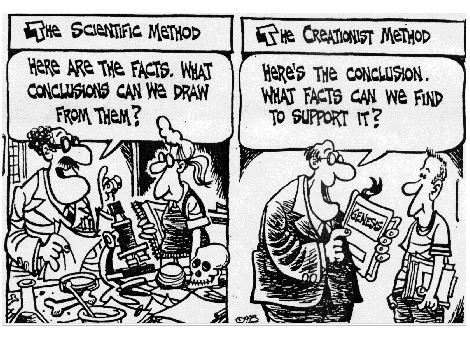
So what is the problem with Johnson and other fundamentalists? To quote Johnson himself, "Rational beliefs are those that are consonant with reality." (P, 10) Because science doesn't attribute everything to supernatural micro-management of God and leaves some elements to chance, he feels it undermines the Bible. Sorry, science works on reason and verifiable proof, not revelation. The other fact is science/reason actually produces results, something the claims of magic have always failed to do. Science at the same time doesn't address the matter of God at all. It comes down to a literal Genesis and the Adam/Eve story and original sin, which Jesus never mentioned, but was created by the Apostle Paul.

How revealed religions such as Christianity, Judaism, and Islam derive truth is by divine revelation. That is direct communication either directly from God via voices visions, etc. or by angels and other divine massager. All we have is the word of the founder, because Christians (as an example) claim angels can't be seen. This revealed "truth" can't be disputed and all other ideas must be derived from it. So anything "observed" must be seen in the light of revelation. To quote Tertullian of Carthage: (150-225) "Divine revelation, not reason, is the source of all truth."

Phillip Johnson is a law professor and lawyer and knows little about the workings of science. Science is based on naturalism and thus deals only with what can be observed. Johnson considers naturalism a religion. (He uses other terms such as modernism and liberal rationalism, etc.) As a lawyer he plays a deceptive game of words mixing liberalism, rationalism, etc. then claims they have no relation to nature. (Which he says is God) What he really object to is a marginal treatment of Christianity; "the establishment of a particular religious philosophy does not imply competing philosophies are outlawed, but rather they are relegated to a marginal position in private life"

On a California textbook policy change, "this policy encouraged textbook publishers and teachers to give much greater emphasis to accepted scientific doctrines and to relegate any consideration of nonscientific subjects such as divine creation, ultimate purpose, and the ultimate cause of the physical universe to literature and social studies classes." (P. 40-43)

Science does not deal in questions of God or ultimate purpose to begin with. Even he admits these are nonscientific subjects, thus they don't have any place in the science classroom. The facts are only 5% of the population is atheist, 95% believe in God. Over half believe in evolution as fact, but over 80% of those believe in theistic evolution or evolution as the work of God. What they don't buy is his particular Protestant Evangelical religion. To Johnson and other fundamentalists, he is in a cosmic battle of good and evil. There is no in between and he means literal six-day Creationism and a historical Adam.
...
What is more important is Darwin never invented any "Theory of Evolution." He promoted the hypothesis (oh, that word again!) that species evolved by random mutation and random chance. Modern science provided the proof he was basically right and thus it accepted by many as fact today. The "fit" would survive by some natural advantage and the least fit wouldn't. Does that mean if the bubonic plaque wiped out the human race that the decease was more intelligent (fit) than man? Of coarse not, that is an element of chance.

Today most scientists know evolution works within known parameters but there is also an element of chance as well. Darwin did not use fossils or radioisotope dating (radioactivity would be discovered in the 1890's after his death) nor did Darwin ever apply natural selection to civilized human beings. To quote Darwin himself: "Under civilized conditions the social and cooperative virtues were useful characteristics assisting in survival, so that we may expect that virtuous habits will grow stronger, perhaps becoming fixed by inheritance."

And evolution doesn't deal any deathblow to Christianity because most reasonable Christians (excludes fundamentalists) see the Old Testament as symbolic and reject Mosaic Law as done away with Jesus. I know several very strong church-going Christians who have no problem with evolution. Many fundamentalists today follow a cult known as Christian Reconstructionism that does away with Jesus (they refer to Jesus/Jews and their God as Satan) and prefer the Old Testament as the Law and themselves as the new chosen people. Followers of Jesus who actually believe in Him have no problem with evolution.

What really upsets many people is uncertainty, that the universe isn't really an orderly, predictable thing. Yes it is orderly within certain points; such as gravity will make a bowling ball dropped on one's foot painful. One could simply never bowl again or go near a bowling alley and be fairly assured that a bowling ball won't fall on their foot. If a meteor the size of a bowling ball hits you in the head, you are dead; there was no way to prevent it. That is random chance.

Life in reality is both, 50% random chance beyond our control, and 50% what we make it. Genetics plays the biggest part of all in cancer, so those who eat only brown, organically grown rice may die of cancer as easily as anyone may. One knows that not smoking tobacco lessons the chance one may get lung cancer, but sometimes we still can. Our choices in life only change the odds, but in the end we all die, nobody knows for sure beyond that.

I don't believe in modernism which says everything is relative and there is no right or wrong. Humans have intelligence and are not animals vulnerable completely to the whims of nature. To quote Einstein himself, "I shall never believe God plays dice with the world." We can make choices if we can separate what is certainly and stop wasting our time chasing phantoms. God gave us the ability to make choices for good or evil.

Life is uncertain as social, technical, and economic changes are a fact in today's world. Many people refuse to, or just can't handle the world around them, so they turn inward. In America this is made worse by an appalling education system that leaves millions in confusion unable to separate science from science fiction and religious faith from blind superstition and mysticism. All of this confusion limits many choices one could make.

Mr. Johnson's entire 245-page book never mentioned anything Jesus ever said, just his own frustration with the world. He wants his version of a spiritual world to be physical reality. Jesus clearly separates the spiritual from the physical world and is right on this matter as are many church fathers. I don't think these people believe what they preach, because if they did they wouldn't care what others think, and would be happy with life. The happy Christians, the ones who actually follow Jesus, who live as He says to live, aren't screaming at the world from the pulpit. I salute them.

The problem with fundamentalists like Mr. Johnson is we live in a technical and diverse world and they just can't handle it. Nobody tells any Christian in this country how to pray, when and where to go church, or what to believe. Nobody! They preach politics, power, and money, not God. If they want to remain ignorant and uneducated, that is their choice. If they refuse to read the Bible and substitute their own self-revelations and political nonsense over the words of even conservative Christian scholars, they are free to do so. If Mr. Johnson wants to write a book claiming some unfounded garbage that the science community is conspiring to destroy Jesus, he is free to do so. (I bought his book, which I'm certainly free to do.)

If these fundamentalists want to attack even their fellow Christians because they don't see the same flat, 6000-year-old earth they see, that's fine. If they choose to be beyond reason and live in some fantasy world, it is their choice.

But they can't force the rest of us to follow them or meddle in the personal lives of other people. I've been in the scientific and technical fields for over 25 years and the fundamentalists leave us only two choices: believe in their flat-earth world or atheism. They drive millions out of the Christian community and often into irrational New Age religion. There is a third choice.

Get an education and read the Bible for yourself. I'm glad I did or I'd be an atheist! Stops adding in things that are not there! The recent Y2K fiasco was the work of fundamentalists Christians (along with New Age technophobes) who thought they knew more than the Bible did. These people are preaching politics, not Jesus. The Bible is not a science book or was not meant as a history book.

The earth is not 6000 years old, evolution is accepted scientific fact, and the Bible isn't threatened by it at all if properly studied and considered. Most of all allow an element of reason into these discussions and stop hunting for Satan under every rock. Finally, if being a Christian produces only anger and resentment of others, go find a new church. There are plenty of good Christian churches around that don't act like cults or endlessly attack everything they don't understand or refuse to deal with. It is up to you!

(Read more: Here).